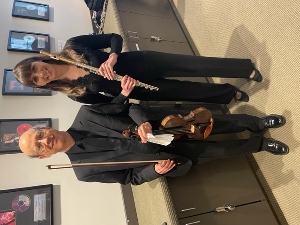
NAC Masters: Getting to Know Leslie Fagan and John Maple

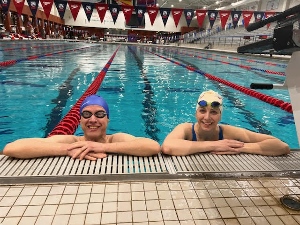
Swimmers by day. Professional Symphony Musicians by Night.
How did you discover NAC Masters?
John:
Word of Mouth.
Leslie:
I discovered Masters when I was a grad student at Northwestern. I always loved swimming; I swam with my neighborhood team during the summers as a kid, but I hadn't done it in years. I started swimming again on my own at Northwestern and noticed what looked like an adult swim team. I didn't really understand what it was since I had never heard of Masters. I finally asked the coach … joined the team … and have been swimming ever since. That was over 20 years ago. One of the great things about Masters is that it's everywhere! When I moved to Omaha to play with the symphony there, I joined a Masters team, and then when I moved to Nashville in 2016 to play with the symphony here, I joined NAC. It's been great not only for the swimming aspect, but it has also plugged me into a community right away each time I have moved to a new city.
How long have you been swimming?
John:
I started swimming with Music City Masters at the downtown YMCA in the early 1990s and started with NAC in the early 2000s.
Leslie:
Because she wasn’t a strong swimmer, my mom made sure all her kids (I have three brothers and one sister) learned to swim. I started swim lessons at age three or four, but I didn't join a team until I was eight in Ft. Wayne, IN. Getting up early for practice and jumping into a cold pool was always a challenge, but once I got moving, I loved the feel of the water! And I remember how great I felt once swim practice was done!
What gets you in the water?
John:
If I don't swim three or four times a week, I just feel off.
Leslie:
I still feel the same way during and after swimming now as I did as a kid … it's painful to get in the water at first, but then it feels great!
I always feel better mentally and physically after a swim. People talk about runner's high, but I think there's a swimmer's high, too! That's what motivates me. Early morning practices are still hard for me—
especially with a job where we perform at night several times a week—
but I try to make some early practices. I go to the noon practices when my schedule allows.
How does swimming help your musical performances?
John:
Swimming keeps me alert unless I overdo it.
Leslie:
Playing the flute takes a lot of air, and I think swimming really helps with my lung capacity.
Playing a musical instrument for hours each day requires a lot of physical and mental stamina, and swimming helps keep me feeling physically and mentally in good shape.
How does Ashley compare to your conductor?
John:
They both push us to give more and to be better; neither takes excuses.
Leslie:
Ashley is like a conductor because she tells us how fast to go! Just like a conductor leading an orchestra, Ashley motivates and inspires us to put forth our best effort. In an orchestra, we all do our individual part, but a lot of the joy of music making comes from doing it together in the moment with others. The same thing is true with Masters, and Ashley's focus and energy set the tone of each swim practice and make the workouts really feel like a fun group effort
Where are you from and how did you end up in Nashville and NAC?
John:
I'm originally from Oak Park IL, and I auditioned for the Nashville Symphony because it was a little further down I-65 from where I went to school in Bloomington IN.
Leslie:
I’m originally from Fort Wayne, IN. I went to Indiana University, studied in England for a year, and then went to Northwestern where I got my Masters and Doctorate in Music Performance. I played for the Omaha Symphony for nine years and then moved to Nashville in 2016 and joined the Nashville Symphony.
Q. What’s the biggest difference between playing in the symphony and having a regular job?
John:
Our schedule is more variable than a regular job and the work itself is another world. We perform mostly on the weekends which limits participation in swim meets. It can be difficult to switch from performing at night on the weekends and getting up early for practice the following week. Also, I have a rule - no swim meets on concert days – because swim meets make me stupid!
Leslie:
The performance nature of our job generates a sense of excitement and accomplishment. It's really a privilege to bring music to life and bring great beauty and art to audiences. Also, our job is not ‘9 to 5,'and our hours vary week to week depending on our rehearsal and concert schedule. For each program, we rehearse together as an orchestra several times a week and typically give two to four performances, depending on the type of concert. We also practice our parts on our own at home which helps us learn the music, keep in shape on our instruments, and come prepared to rehearse with the full orchestra.
Q. What do your colleagues say when you tell them you swim so early in the morning?
John:
You are crazy.
Leslie:
They think I’m crazy.
Q. What are your goals? On stage and in the water?
John:
Excellence on stage and I’d like swim times closer to what I did 20 years ago.
Leslie:
My goals on stage are to always bring my best and keep growing musically. I want to perform well for the audience, colleagues, and listeners.
I like to push and challenge myself in the water. I want to work out as hard as I can and get the most out of every workout.
What are some things people may not know about you? Besides being in the symphony? What instruments do you play and for how long?
John:
I enjoy tinkering with computers and cars. I've played the violin since I was eight.
Leslie:
I started playing the flute when I was eight years old. I have two Siamese cats.
What haven’t I asked you two?
John:
Do you say soda or pop?
I say ‘soda.’
Leslie:
I say ‘pop.’
More photos: