400 IM Race Strategy

400 IM Race Strategy
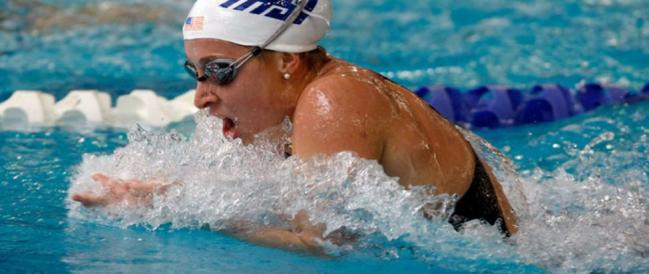
Courtesy of Linda Hass//Correspondent
One of Ariana Kukors' strengths in the IM is the backstroke, so you'd think she would play that ace for all its worth. But you'd be wrong. It may seem counter-intuitive, but she has learned that if she beats it in the back, she can quickly deplete her energy for the remaining strokes.
"It's tempting to go all out in your strong strokes, but my race strategy is to maintain a steady tempo in the back," said Kukors.
Her coach, Sean Hutchison, agreed.
"For Ariana, the backstroke is the key,” Hutchison said. “If she uses her legs too much, not only does it deplete her energy for the next stroke, it sets up her arm tempo so that it's too slow for the next transition."
Resisting the temptation to over-do your strong stoke is a common challenge for many IM specialists, he added.
Another important strategy for Kukors is to stay in her own lane mentally and not be distracted by competitors' positions.
"I try to stay focused on my own race and not get caught up in where everyone else is," she said.
While she has a general idea of competitors' locations, based on peripheral vision, she does not allow herself to become preoccupied with it.
While she has a general idea of competitors' locations, based on peripheral vision, she does not allow herself to become preoccupied with it.
Kukors has come a long way from the stroke of her original preference: the 50 freestyle.
"There was not a lot of strategy to it," she said chuckling. “I just went as fast as I could."
So why did she switch from the shortest, fastest sprint possible to the individual medley, which requires finesse and power in four strokes?
"I didn't choose it; it chose me," she said. "I found that I could do it well, and I have grown to love it."
She also has grown to do it very well. Kukors finished 2007 ranked seventh in the world in the 400m IM and has qualified for the U.S. Olympic Team Trials – Swimming in nine events, including the 200m and 400m IM.
MORE ON KUKORS' RACE STRATEGY
How important is race strategy to you?
Kukors: For me personally it's more important for the 400m IM because of the need to pace myself and maintain a tempo that will work for longer distances. The 200m IM is more of an all-out sprint.
What is your race strategy for the 400m IM?
Kukors: For the fly, my strategy is to go out fast, but not so fast that I burn all my energy; for the back I try to maintain an even tempo; for the breast I focus on long strokes to get a good glide. For the free, well, there is no strategy. I just go as fast as I can.
Does your strategy ever change?
Kukors: All the time. It depends on what my strengths and weaknesses happen to be. When I was a kid, I used to always be behind in the fly. I think I tried too hard. To compensate, my strategy was to focus on staying relaxed. Since I've improved my fly, my strategy now is to maintain a fast but steady tempo.
What's the best advice you've ever been given about race strategy?
Kukors: Whatever my coach tells me to do!
Kukors: For me personally it's more important for the 400m IM because of the need to pace myself and maintain a tempo that will work for longer distances. The 200m IM is more of an all-out sprint.
What is your race strategy for the 400m IM?
Kukors: For the fly, my strategy is to go out fast, but not so fast that I burn all my energy; for the back I try to maintain an even tempo; for the breast I focus on long strokes to get a good glide. For the free, well, there is no strategy. I just go as fast as I can.
Does your strategy ever change?
Kukors: All the time. It depends on what my strengths and weaknesses happen to be. When I was a kid, I used to always be behind in the fly. I think I tried too hard. To compensate, my strategy was to focus on staying relaxed. Since I've improved my fly, my strategy now is to maintain a fast but steady tempo.
What's the best advice you've ever been given about race strategy?
Kukors: Whatever my coach tells me to do!