What Competitive Swimmers can learn from big-wave surfers


What Competitive Swimmers can learn from big-wave surfers
By dr lenny Wiersma
Department of Kinesiology, California State University, Fullerton
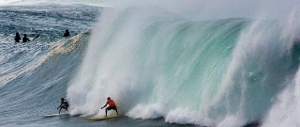
Recently, I spent a sabbatical conducting interviews with surfers who face 50-plus-foot waves, chilling waters and the occasional great white shark at Maverick’s, a big-wave surf spot in Northern California. I wanted to know about the psychology of participating in a very dangerous, uncontrollable and uncomfortable environment. Some of the things they discussed, believe it or not, transfer a lot more to competitive swimming than you might imagine. Here are three things you can learn about sport psychology from big-wave surfers:
1. Focus on the right things before a race
1. Focus on the right things before a race
Billabong provides awards every year for performances such as “Biggest Wave” and “Best Wipeout.” Each performance must be filmed and verified by video or still photos, and the winners in each category win as much as $15,000 plus other big-ticket items such as jet skies or surfing gear. Most of the surfers I interviewed thought the idea was the worst thing for surfing, as it made people do stupid things for the wrong reasons, putting both themselves and others in danger. One surfer said, “If you are paddling into a wave and thinking about money and not focusing on the wave, you’re going to fail. Hard.” When you are about to get on the blocks before a race, are you thinking about making a time cut, or are you focusing on your race plan? Are you focusing on trying to please your parents, or are you focusing on things more in your control, such as deep breathing? It’s best to focus on the process, not the outcome, of your race. Or you may “wipe out” badly.
2. Stay in the moment
2. Stay in the moment
Speaking of focus, big-wave surfers recognize the importance of their ability to stay in the moment during their performance. One surfer explained it this way: “I can’t look at the whole wave because it is terrifying in my mind. So when I drop into a huge wave, I need to keep my focus two feet in front of the board. In my head, I have to stay there. If I am thinking about whether I am going to make it or not, I am not focused on what I need to do to make it.” The same holds true for swimmers: If you are thinking about winning or losing, you aren’t thinking about your pace, your stroke, or other technical aspects of your race, such as dolphin kicking off the wall. While it may be tempting to be focusing the outcome of the race, you really need to discipline yourself to focus on what you are doing in the moment. The outcome of the race will take care of itself.
3. Don't make an event harder than it needs to be
3. Don't make an event harder than it needs to be
Big-wave surfers are completely conscious of the dangers involved in their sport, but they also recognize that they are knowledgeable, well-prepared, and sufficiently skilled to take on extreme surf. They know they have what it takes to be successful and, while they have great respect for the power and unpredictability of the ocean, they don’t make it any scarier in their mind than it needs to be. The same holds true for certain events in swimming; many athletes I’ve worked with make events like the 1,650 free or the 400 IM seem like the 10,650 free or the 4,000 I.M. in their minds. Even though they are sufficiently prepared to swim these events well, they create mental obstacles for themselves by making them seem “scarier” than they need to be. Remember that while these events may seem more difficult than others, if you can embrace the challenges they pose, you just may be able to use this perspective to your advantage in a race when things get tough.
.