Swim Meets
A swimming competition is often referred to as a swim meet. Swim meets occur at the local, zone, sectional, national and international level.
Most USA Swimming meets at the local level are an invitational-type format with multiple teams competing at once against each other. A true ‘invitational’ meet indicates teams are ‘invited’ to attend; an ‘open’ meet indicates any team is allowed to attend; most meets are open to any team that wishes to attend. Meets generally have hundreds of swimmers, many teams and many different events.
Progressions of a Swim Meet
Preparing for a swim meet:
- Swimmers should plan on not missing practice the day before a meet unless otherwise instructed by their coach.
- Swimmers should get a good night’s rest and fuel their ‘machine’ with the proper nutrition to compete both in the meal the night before and the morning or day of the meet.
- Parents should bring camp chairs, blankets, parkas, towels, snacks, beverages/water, games/activities to keep their athlete warm, fueled, hydrated and comfortable for the meet. Swimmers are not allowed to consume energy and caffeinated drinks at the swim meets; not only are these not healthy but will only hinder your athlete’s performance.
- Swimmers should bring their racing gear which includes a proper competition suit, cap, goggles. Also important to bring is a water bottle, shoes, additional clothing and towels that can get wet and a parka or warm jacket. Often swimmers must walk through lobbies and areas with different temperature during meets; to set up swimmers for success, it’s important they stay as warm and dry as possible.
Meet Warmup:
- A few days prior to the meet, the Head Coach will send instructions as to when swimmers need to report to the meet and check-in with their coaches.
- Generally, teams are assigned specific warm-up times and it’s important that all swimmers get in on time to gain the proper warm-up for peak performance.
- Some meets will separate warm-up into General and Specific. General means simply all lanes will be used for general swimming warming up. Specific means certain lanes will only be used for one-way starts, others for push-pace work and the remainder for additional general swimming warm-up.
- After the team has completed warm-up together, swimmers will meet in our team area for a meeting and our team cheer. Swimmers should coordinate with their coaches and appropriate time to change into their ‘meet suit’ if they choose not to warm up in it so as not to miss any warm-up, team meeting or the cheer.
Before & After Events:
- Prior to the start of the meet, swimmers might like to locate their events in the meet program or heat sheet and write them on themselves to keep track of their races; generally, this is for younger swimmers. Parents can also assist swimmers in locating and writing this information.
- Write the information as follows:
- Column labeled ‘E’ – for the event # number
- Column labeled ‘H’ – for the heat the swimmer is in for that event
- Column labeled ‘L’ – for the lane the swimmer is in of that heat and event
- Swimmers also write the name of the event next to the ‘L’ column, such as 100 FREE
- Write the information as follows:
Your swimmer’s arms should look like this:
E = Event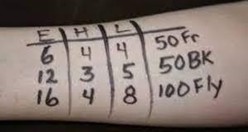
H = Heat
L - Lane
- Before the meet starts and between their events, swimmers are encouraged to relax with their family, friends or teammates, keeping physical exertion to a minimum to rest and preparing for their events.
- Swimmers should remain hydrated, warm & dry as well as keep energy up with snacks. Reminder: NO energy or caffeinated drinks for swimmers as this is not healthy and will negatively impact their performance.
- Prior to going back to their spot to rest, swimmers should ask their coaches the time of the meet (event & heat) they should come back to talk to the coach and warm up for their next race. It’s important that swimmers learn to pay attention to their event timing and the progression of the meet as not miss races.
- At the pre-arranged time, the swimmer should proceed to the pool deck with their cap, goggles and any items for racing to discuss their race strategy with their coach and warm-up for the race, if needed.
- Pre-race talks with coaches are simple and brief, used to talk strategy and hit reminders for that particular swim as well as to positively encourage a swimmer to greatness. Swimmers will not be successful if they do not talk with their coach beforehand about reminders and key things to focus on for their race.
- Post-race is equally as important and should only happen after a swimmer has cooled down after their race. Coaches will give constructive feedback on their swim, advice on technique or racing as well as splits from that race. Swimmers will not be successful if they do not communicate with their coaches about their race and how to improve.
Events:
- Swimmers are expected to report behind the block, several heats prior to theirs, ready to compete and will step onto the blocks when the starter calls them up using certain whistle blasts.
- If a swimmer misses their event, please allow the coach to deal with the situation. Swimmers are instructed to immediately talk to the starter should this happen. It is possible that officials can get swimmers into future heats/lanes that they know swimmers are absent; however, it’s not a guarantee. There may be other rules that factor into this situation, see Championship Meet Rules above.
What is a ‘session’ of a meet?
Most meets are a 3-day setup (Friday evening, Saturday & Sunday-all day) with designated sessions to compete by age groups. Friday evenings typically are longer events for both age groups. Saturday and Sundays are separate sessions, morning and afternoon, split by age groups; the meet host will make this determination. 12 & Under sessions are required to stay within a 4-hour limit, from the start of the session to completion.
What is a’ heat’ of an event?
A heat refers to a single race within a swimming event. The number of heats is determined by the number of athletes entered in the prelims session or those qualified for the finals session of a particular event. Winning a heat does not automatically mean that a swimmer has won the event or qualify a swimmer to the next stage. Times recorded from all heats of an event will determine a swimmer’s place in the event unless the race is during the finals session (see Prelim/Final meets below).
Timed Final and Prelim/Final Meets
Swim meets are typically held in one of two formats:
- Timed Finals (TF): Swimmers compete in an event once. Final placement is determined by ranking all recorded times across every heat, regardless of heat order. The meet host decides if heats are seeded from slowest-to-fastest or fastest-to-slowest.
- Preliminaries and Finals (P/F): Swimmers race in preliminary heats, usually in the morning, to qualify for evening finals.
- Qualifying: Typically, the top 16–20 swimmers from prelims advance to the final session, which is split into a Championship heat (A-Final) and a Consolation heat (B-Final).
- Ranking: Results are determined by placement in the final race, not necessarily by the fastest time overall. Swimmers in the A-Final compete for 1st through 8th (or 10th) place. Swimmers in the B-Final are ranked behind the A-Finalists (9th through 16th/20th), even if their final time is faster than someone in the A-Final.
Alternates
Heats in a finals session can also include 2 alternate positions. These swimmers will get the chance to compete, only in the ‘B’ final heat, should a swimmer either scratch from the finals session of that event or ‘no-show’ when the official calls swimmers in that heat to the blocks for that heat. Therefore, it’s important that swimmers deemed as alternates not only show up to the finals session but prepare for the race as if they are swimming; there’s always a good chance alternates will get the opportunity to swim.
Finals sessions often designate two alternate positions for each event. These athletes have the opportunity to compete—typically in the 'B' final—if a qualified swimmer either scratches from the event or fails to appear behind the blocks when called.
Important for Alternates:
- Be Prepared: Alternates should attend the finals session and warm up as if they are guaranteed to race. There is a high probability that an alternate will be called to fill a vacant lane.
- Check-In: Alternates must remain near the blocks during the heat staging process to ensure they are available if a "no-show" occurs.
Swim-Off’s
In a prelims-and-finals meet format, a swim-off occurs if two or more athletes tie for the final qualifying spot (or an alternate position) in a championship heat. This additional race resolves the tie and determines who advances to the finals. The Meet Referee coordinates with the affected athletes and coaches to schedule the race, which must occur during the preliminary session. Only the tied swimmers compete in the race. If the swim-off itself results in a tie, the athletes race again until a winner is determined. With mutual agreement from the swimmers, coaches, and the Referee, a tie may be resolved through a coin toss or by racing a different distance. If a swimmer is disqualified during a swim-off, the spot is awarded to the next fastest swimmer who finishes legally. All legal times achieved during a swim-off count toward team records and future seeding.