
Frequently Asked Questions
How will I be notified about practices, meets, and other important information?
Email will be our primary form of communication for any important infomartoin and is monitored by Board members. We do not plan to overwhelm you with email, so please be sure to read all email sent from the team. This will ensure you have all of the latest and most accurate information about your swimmer. Should your email change, please be sure to update your email address in your account to ensure you receive all communications.
Our website, www.BayCityAquatics.org, contains a lot of information and is where you will go to register your swimmer(s) for meets and upcoming seasons. Please be sure your contact information on our website is accurate. Email is sent through the registration system to announce upcoming meets and season registration windows.
Communictions may be sent using the Remind App and will be delivered to you by text message. Please be sure your contact information is accurate and be sure to text to the Remind code provided in the seasons Welcome email, to be sure you're receiving the most up to date communications. Timely information such as practice changes due to inclement weather will be communicated by Remind messaging.
Instructions to sign up are posted on the North wall of the pool.
Updates and announcements are also posted on the team’s Facebook page. Be sure to like and follow Bay City Aquatics Club to ensure you are staying connected during the season and in the off season!
What does my child need for practice?
All required gear can be found at our Swim Outlet Team Store
Girls need a one-piece swimsuit, goggles and a swim cap for each practice.
Boys need either a swim brief or a long-line jammer-style swim suit, goggles and a swim cap.
Latex swim caps with the team logo are available to all swimmers at no cost. If your swimmer would like a silicone cap with the team logo please sign up on the north wall of the pool. The cost is $12-14 each and they will have to be special ordered.
Junior & Intermeidate Swimmers will be required to bring their own training fins and kick board, these are not provided at the practice locations.
All swimmers need to bring a refillable water bottle and a towel to each practice AND a completed concussion awareness form to be signed by them and you before the end of the first week of practice. Your swimmers may also want to wear flip flops, slides, crocs or other waterproof shoe while on the pool deck.
How many seasons are during the swim year and how long does each season or session last?
Our swim club has four seasons: Fall, Winter, Spring and Summer.
Our Fall season starts in mid-September and ends just before Thanksgiving.
Our Winter season starts right after Thanksgiving and ends in February following the Championship meet.
Our Spring season starts in April and ends in late May.
Our Summer season, which is typically a Long Course season, starts in June and ends in late July / early August. This may vary by year and depends on the status of our outdoor community pool.
During the break between our Winter and Spring seasons (Mid-February through Mid-April) and if your child has qualifying times, your swimmer may compete in one or more of the following: MTSL State Meet, Junior Olympics, Michigan Swimming State Meet or others. This time, Mid-February to Mid-April, is dedicated to the championship meets as well as a period of rest for swimmers to come back in the Spring refreshed and ready for another great season.
The practice location for the Summer session may vary depending on the availability of the outdoor community pool. Summer long course season differs from the other seasons because the meets are held in 50-meter pools rather than the 25-yard pools. Our Intermediate and Senior groups practice at the Bay County Community Center in a heated 50-meter outdoor pool during the Summer season. Our Junior group practices at John Glenn High School in a 25-yard indoor pool and we invite them to join the other groups for a practice or two to experience outdoor long course swimming. Coaches will communicate with parents and swimmers when they plan to have practice at the Community Center.
What special equipment or gear is needed for practice?
Gear needed at practice will differ among the groups. Please refer to our Swim Outlet Team Store to find the required equipment for your swimmer.
You can also find this page from the home page of SwimOutlet.com select Teams > Team Store > Find your team store > search by zip code (48706) and select ‘Bay City Aquatics Club.’
By selecting our swim team before making any purchase, a portion of your purchases is donated back to the team from SwimOutlet.com. This site is a strong supporter of the sport and its athletes.
We will be adding team-branded items in the future, but you may purchase anything your child may want or need.
Why parents aren’t allowed to stay for practices?
Young swimmers want their parents’ approval more than anything. If they know you are watching practice, it’s only natural for some of their attention to be directed to you. However, for the swimmers to learn as much as possible, it is imperative coaches have your child’s undivided attention during practice. We ask that you not communicate with your child during practice thus competing with a coach for his/her attention. Second, we insist that parents do not interrupt the coaches on deck while they are coaching. If you need to communicate with a coach, please do so 5 minutes before or 5 minutes after practice or arrange another meeting time that works for your family as well as the coach. With these various points in mind, we ask parents to stay out of the pool area during practice hours.
How do I register for swimming seasons?
We send emails to our returning swimmers that contain a link to register for swimming seasons. You will be prompted to login to your account then proceed with registering your swimmer for the season. You can also access season registrations without the link. Simply log in to your account, then choose My Account > Team Registration.

Registering for a swimming season using a phone or tablet can be very frustrating due to drop down lists not displaying properly. To avoid frustration, please complete your registration from a computer.
What is MTSL?
Our swim team competes in the Michigan Team Swimming League (MTSL) swimming league. The MTSL meets allow us to compete with swimming teams from Northern and Mid-Michigan. Your child’s results, or times, from swim meets are captured and used to determine qualification for MTSL Championship meets.
Which meets are best for my swimmer?
Most of our beginner swimmers get great first experiences at MTSL meets. Some of these meets are Dual Meets meaning our team and only one other team is competing. These meets are often popular with the beginner swimmers. Your swimmer will compete with other swimmers in the same age group. This is a great way to meet swimmers from other teams and make new friends. Experienced swimmers must compete in at least two (2) MTSL sanctioned meets to be eligible to compete in the MTSL State Championship with qualifying times.
How do I sign up for meets?
Our website is the place to sign up for swim meets. After logging in with your username and password, select Events from the menu and you will find all current meet registrations there. However, the fastest and easiest way to declare or decline a meet is through the OnDeck app. Download the app from the Apple App Store or Google Play Store.
Your log in and password is the same as your account on our website.
Meets will be communicated to swimmers by email which will contain a link to commit or decline for the meet. The link will take you to our event registration system and you will be prompted to log in to your account. The link is not required to declare through the app. Meets will be visibile in the app when they are open for signups.
Meets will have a meet packet attached to them that contain all the details about the meet such as location, events, wamup and meet start times, etc. Please refer to the meet packets when looking for details about a meet.

How many meets should my swimmer should participate in each season and why should they participate in meets?
Beginning swimmers are encouraged to swim in 1-2 meets per month, and experienced swimmers are encouraged to swim in 3-4 meets per month. Meets provide proof of improvement and are the culmination of the hours of hard work put in at practice. Meets also build team camaraderie and teach swimmers how to face challenges. But most of all, they’re fun!
Where are the meets located?
All meets during the regular season are within Michigan. Our team has competed in meets hosted in Standish, Lake Orion, Oxford, Saginaw, Dexter, Saline, and various other pools around our state.
State Championship meets have been held at the Eastern Michigan University and University of Michigan pools. If your swimmer should qualify for a Sectional Championship Meet, they will have the opportunity to swim out of state.
What is the cost for a meet?
As a general guide, costs to participate range from $15 to $40 per meet. Costs vary based on the number of events your swimmer competes in during the meet. After the deadline to sign up for the meet, the host team charges Bay City Aquatics Club the total fees for our swimmers to participate therefore meet fees are NOT refundable.
What is my role as a parent in my swimmer’s success?
Your swimmer will practice and compete in an environment which is safe, encouraging and supportive. Their coach will guide your swimmer to improve their techniques, to do their best and to be a supportive, respectful team mate. As a parent, you should encourage them to have fun during practices and meets, ensure they are coming to practice ready to work hard, have fun and learn more about swimming. Leave the discussions about swimming techniques to the coaches. Your child needs you to be a supportive parent.
What is my role as a parent at a swim meet?
Many meets require swimmers to check in upon arrival. The volunteers at the admissions desk can direct you to the swimmer check in area. Be sure your swimmer is checked in and marked as in attendance and ready to swim.
Parents are not permitted on the pool deck during swim meets so be sure your child knows where you are sitting. Only swimmers, coaches and volunteers are allowed on the pool deck.
During the swim, cheer for your swimmer (and their friends) and encourage the swimmer to cheer for teammates! Good sportsmanship starts with you. Remember that improvement and personal accomplishments are more important than winning.
When a swimmer swims poorly, continue to focus on the positive things that happened in a race. It’s okay if a swimmer negatively evaluates a performance; just don’t dwell on it—think about improvement and focus on fun.
When a swimmer has completed all of his or her events, the swimmer and the parents get to go home. As a parent, praise your swimmer and his or her effort. But remember, let the coaches coach!
Some meets will require Parent volunteers. Our Coaches and Leadership will communicate out voluteer opportunities and every family must sign up for at least 1 volunteer opportunity each season.
What should we bring to a swim meet?
- Your team suit, cap, t-shirt and other team apparel. It is a good idea to have two pairs of goggles and two caps. You may want to bring more than one towel as your swimmer will be in and out of the pool several times.
- Extra clothes - Since it can be chilly at some pools -- especially at outdoor meets during the summer -- bring sweats, warmup jacket and pants, parka. Crocs, flip flops, slides or other waterproof shoes can be worn on deck and must be worn in all other areas. Also have two or three towels, since you’ll be in and out of the pool several times.
- Food - Although there often is a concession at the meet that offers food and drinks, it is a good idea to pack some nutritional snacks like granola bars, fruit snacks, yogurt, fruit, cereal, bagels, and non-carbonated drinks. Don't forget your water bottle. It is particularly hard to stay hydrated in a pool environment, so bringing water is extremely important for everyone.
- Activities - At some meets there can be a lot of time between events. Bring things to pass time such as schoolwork, travel games, books, magazines, cell phone, etc.
- Your swimmer! - Each family is responsible for their own arrangements and transportation costs; consider carpooling to get swimmers to warm-ups on time.
- Money - All meets charge an admission fee for everyone other than the swimmers, coaches and volunteers. Many host pools have concessions available for purchase.
- A meet program/heat sheet - Heat sheets may be purchased at most meets for $2-$10. Highlighters, pens, and Sharpies are helpful to mark your swimmer's events as well as their friends' events.
- Comfortable clothes - Indoor pools are heated, so is the air around the pool. Dress in layers to stay comfortable. Natatoriums can be very warm for spectators even in the middle of winter.
- Seating (some meets) - Many pools don’t have a lot of spectator room, so get there early and be prepared to exit to hallways or a gym in between your swimmer’s races. Some pools may let you bring a stadium seat. Most bleachers are concrete and hard to sit on for three to four hours. It may also be a good idea to bring blankets or mats for the swimmers or siblings to sit or lie on.
- Folding lawn chairs, sunscreen, hats, sunglasses and water bottles are recommended for outdoor meets.
What should I expect on the day of the meet?
Your swimmer should get a good night’s sleep, eat a nutritious breakfast and bring healthy snacks to the meet.
Arrive so your swimmer can check in then meet with his or her coach 10 to 15 minutes before warm-up. This is the ‘on deck’ time. Warm-ups typically last 50 minutes before the first race. Teams are generally assigned lanes and times for their warm-up sessions.
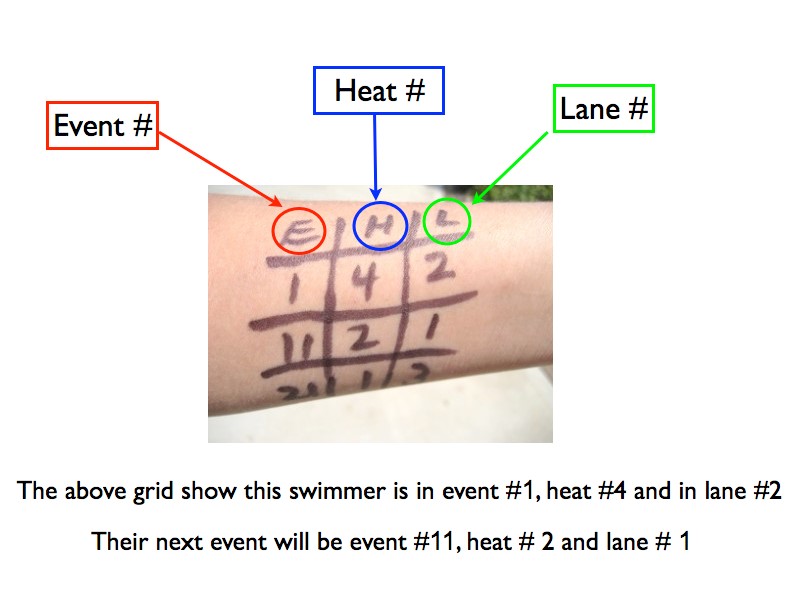
Coaches will arrange a place where the swimmers can sit together as a team. Wearing the team’s shirt helps identify our swimmers. Swimmers should bring their bags with them when they check in with their coach, and will leave it in the swimmer's seating area. After warm-ups is a good time to have your swimmer come to you so you can mark their arms with their race information (event, heat, lane, stroke). A Sharpie is good for doing this.
On the way in, spectators can usually purchase a meet program/heat sheet for $2-$10. Meets are pre-seeded, so the program lists the swimmers by event (the stroke and distance), heat (the grouping of swimmers), and lane (the specific lane in which your swimmer is expected to race for that event). You can keep track of your swimmer's and their friends' performances.
Swimmers will sit with their teammates during the meet, however they can and will come to you for encouragement and parental support from time to time during the meet. Please note: Parents are not allowed on deck at meets, so make sure your swimmer knows where you will be sitting.
Meets are divided into morning and afternoon sessions. Typically, 12 & under competes in the morning and 13 & over competes in the afternoon. 11 & 12 girls will often compete in the afternoons during the short course season.
How do I read a heat sheet and what does NT mean?
Heat sheets detail which swimmers are in each event and in which heat and lane. A seed time is listed for each swimmer to determine in which heat he or she will swim. Swimmers are placed in heats to compete with other swimmers whose times are similar. There may be cases when there are so few swimmers in an event that varying seed times will be in the same heat. If your swimmer has not competed in an event prior to the registration deadline for this meet, a time of NT (No Time) will be on the heat sheet.
Swim meets are organized by event which are then divided into separate girls and boys events. See the example below.
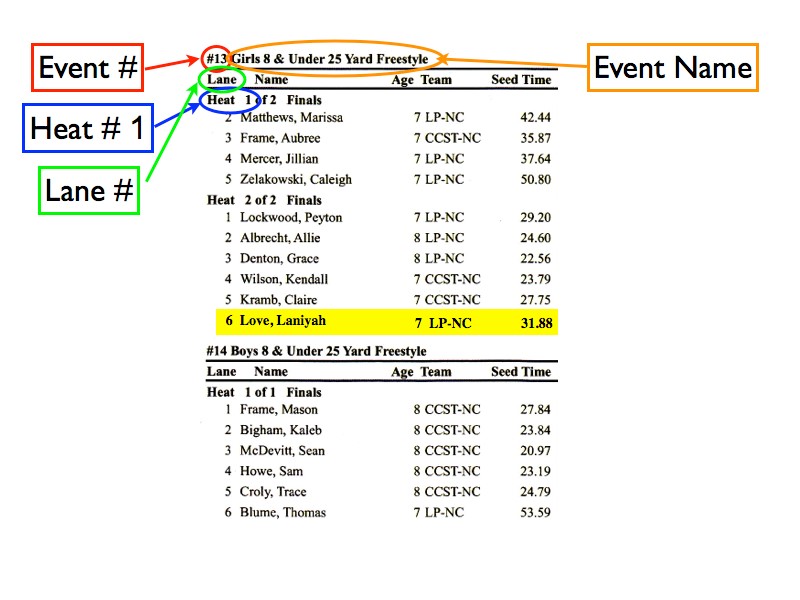
This example shows the event number and event name followed by the heat and lane assignments for each of the swimmers in that event. Your swimmer's age and team name is also listed. Coaches will have a heat sheet so all swimmers know when they are swimming. Coaches also help beginner swimmers to know which events, heats and lanes they are in so they are at the starting blocks when they need to be. Your swimmer can stay organized by using a tic-tac-toe method like this. This is written on the swimmer's arm, usually with a Sharpie, to help them keep track of where they need to be during the meet.
How are age groups affected by birthdays?
Your swimmer's age on the date of the meet determines the age group in which he or she will compete.
How will my swimmer know when they are racing?
The coaches will direct swimmers to the blocks prior to their races. It’s important they be on deck in the team area 20-30 minutes before their race. If they miss their heat, they won't be allowed to swim in that event. However, our coaches will help to get them into another heat when possible.
If swimmers violate a rule, they will be disqualified (DQ'd). Everyone gets DQ’d at times—even experienced swimmers. For beginner swimmers, you should view the DQ as constructive criticism to help them learn to swim legally. It identifies for the swimmer and his or her coach an area that needs to be worked on and improved.
What is a Time Standard?
A time standard is a time set by MTSL that must be reached to compete in championship meets. If your swimmer achieves a time listed as a time standard, or faster, he or she would qualify to compete in the championship meets. Time standards are posted on our website. We do not expect every swimmer to achieve a qualifying time, especially the beginner swimmers, but knowing the Time Standards can give your experienced swimmer a goal to achieve. Time standards for MTSL are linked on the Time Standards page of our website.
What Disqualifies (DQs) a Swimmer?
False start
- If the swimmer jumps the start or moves forward once the starter has said, “take your mark” but before the actual start, he or she “false starts” and will be taken out of the race.
The strokes
- Freestyle: Walking on the bottom, pulling on the lane rope, or not completing the distance.
- Backstroke: Swimmers have to be on their backs when they touch the wall and push off; they cannot pull/kick the wall once they have passed the vertical onto the breast. Swimmers must finish on their backs, and cannot turn onto the breast before touching the wall with the hand.
- Breaststroke: An illegal kick such as flutter (freestyle), dolphin (butterfly) or scissors (sidestroke); not being on the breast; alternating movements of the arms; taking two arm strokes or two leg kicks while the head is under water; touching with only one hand at the turns or finish instead of touching simultaneously with both hands..
- Butterfly: Alternating movements of the arms or legs; pushing the arms forward under instead of over the water surface (underwater recovery); a breaststroke style of kick; and touching with only one hand at the turns or finish instead of touching simultaneously with both hands.
How are swimmers chosen for relays?
At any and all swim meets, the final relay order, athlete list, stroke assignments, etc. will be based on coaches’ discretion. It is the intention of the coaching staff to put together the fastest and most competitive relays possible on any given day, session or meet. Coaches will consider any number of times, including times from that day of racing, to decide upon the final relay order, assignments, etc. Notification of relays to families and swimmers will be done as quickly as possible and in an appropriate manner. If there are any questions regarding relays, have your child connect with his or her coach.
