

Welcome to the Parent Corner! Diving world can sometimes be a hard to understand for the new athletes and parents. Here we put together all the resources you will need to help you feel more comfortable and involved with our club and diving sport in general.
Parents, it's important to remember:"They DIVE, I COACH, You CHEER!"
- Never compare your athlete to others. Diving is about Personal Best, not Better than Others. Each child is developingand pacing differently. Always make a comparison to your child's progress today as to where he or she was the year before.
- When watching a practice or competition, always give equal support to other divers as you would for your own child
- Feel free to approach a coach before, after practice or via email with any questions or concerns.
- Please insure that the diver is on-time, and ready to begin participating when the practice is scheduled to begin. This means that the diver should be dressed out and ready to begin dryland at the designated time, not merely entering the front door.
- Dryland and water equipment can only be utilized when a coach is present and supervising.
- Parents and siblings may watch the water portion of practice, but only from thebleachers. Parents and siblings are not allowed on the pool deck. At facilities where the pooldeck is attached to the bleachers parents must remain in the bleacher area.
- At all times, divers, parents, and siblings should be mindful of other school classes, groups,and activities to insure that we are not disrupting those students and entities.
- Divers must listen and adhere to coaches’ instructions at all times. If a diver has to be asked tofollow directions
 morethan twice, the diver will sit out of practice for 5 minutes or longer. Continued disruptions and inattentiveness will result in removal from the day’s practice.
- Make-up Policy: Due to coaching staff and facility availabilities there are no make-up practices offered. Where possible and space allows, divers may be allowed to come to an alternative practice group for a make-up practice.
- Insurance: Upon the first practice all divers will be registered with USA Diving. USA Diving is the National Governing Body for diving, which supports all levels of diving and competitions including selection of World Championship and Olympic Teams.
Diving Competitions
 Diving meets are a critical element to proficient athlete development. Competitions are the best method for measuring progress, and provides a fun, rewarding experience for a diver's hard work throughout the season. Diving meets are typically one or two day events weekend events, where divers compete in the 1-meter, 3-meter, and often platform events. At the beginning stages divers will typically compete in the 'Future Champions' events which are more skill based, eventually progressing to the 'Junior' level events where divers compete within the 9 & Under, 10-11, 12-13, 14-15, and 16-18 events. Age groups are determined based upon the diver's age as of December 31st of that year. Divers at the highest performance level also compete at the'Senior' level, which removes age restrictions, competing against the top divers in the nation, often including past and future Olympians.Throughout the school year Kansas Diving team members attend competitions approximately every 6 weeks. As there are limited numbers of divers within the metropolitan area, many of these competitions require travel throughout the Midwest. Kansas Diving works diligently in planning these traveling competitions to minimize individual costs, allowing every athlete critical opportunities to compete. Please note that the costs listed are approximate and can alter based upon the numbers of participants at each meet. The meet schedule is subject to change; please consult with the coaching staff before making any advance travel arrangements.
As touched upon above, there are several types of diving meets, and several levels of competitions, but generically, a diving meet consists of several events with divers competing on different levels against a number of other athletes of varying abilities. At nearly all diving meets athletes will have an open warm-up, with all divers warming up in the morning, this is a group practice time. Immediately prior to their event (at the conclusion of the previous event) divers will typically have 30-45 minutes to their event warm-up which will lead directly into their competition. Diving meets consist of rounds, wherein the divers are ordered and perform one dive each round of divers. Diving meets are judged, typically by the coaches from the competing teams. Occasionally at smaller meets experienced parents may judge; however, per USA Diving requirements family members are prohibited from judging events in which their family member is participating. The judges score each dive from 0 (lowest) to 10 (highest) at ½ point increments. Diving meets will have 3, 5, 7, or 11 judges (synchronized diving only for 11 judges). With 3 judges all 3 scores are summed and multiplied by the degree of difficulty to determine the dive's overall score. Each dive has a set degree of difficulty ranging from 1.0 to over 4.0 at .1 increments. With 5 judges the highest and lowest scores are removed and the remaining 3 scores are summed and multiplied by the degree of difficulty. With 7 judges the 2 highest and 2 lowest scores are removed and the remaining 3 scores are summed and multiplied by the degree of difficulty. Determining the role of the 11 judges for synchronized diving judging is a bit like the scoring on ‘Whose Line is it Anyway’.
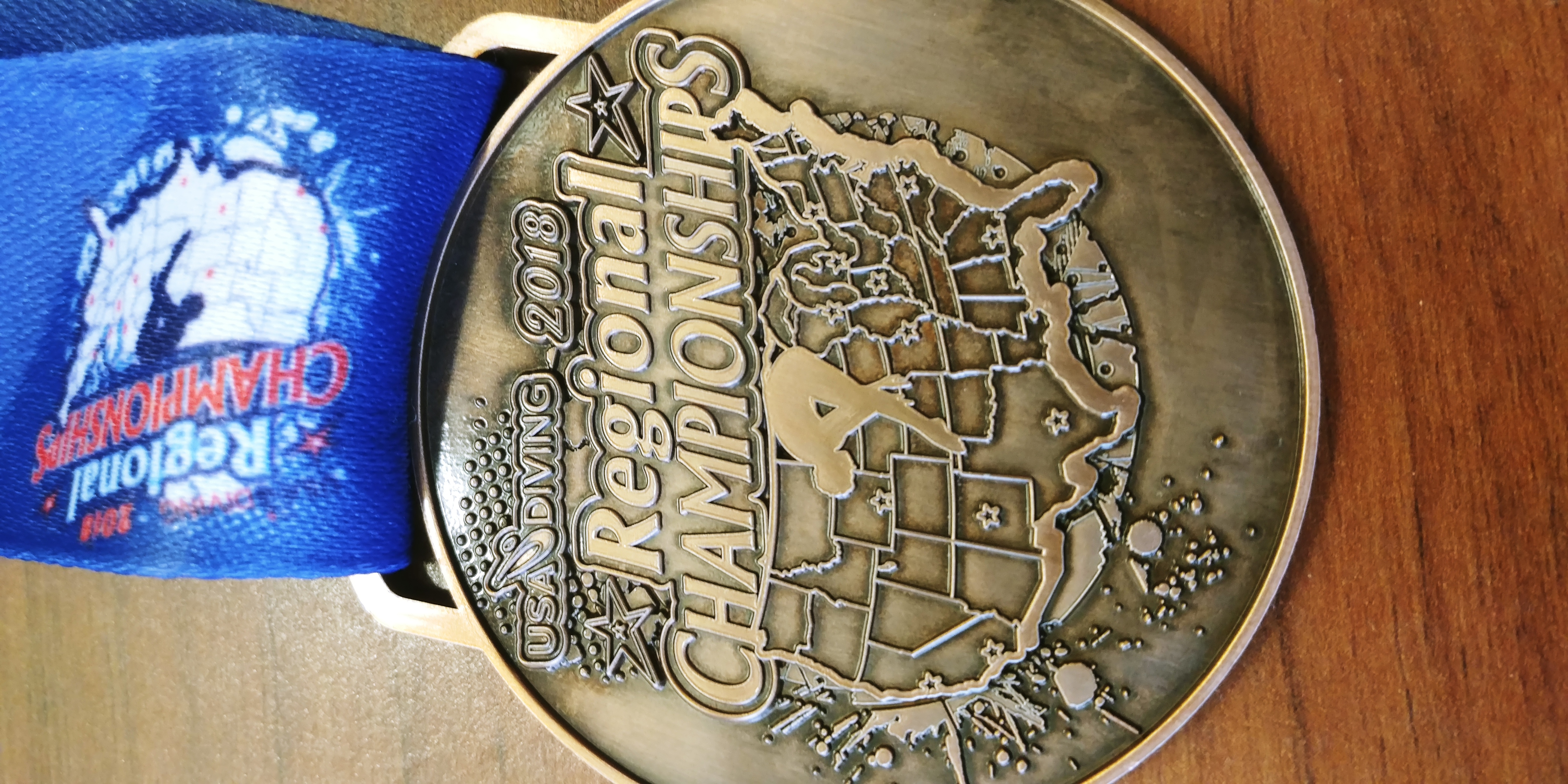
Ultimately each dive's overall scores is summed to get the diver's total score for the event. The diver's total scores determine their place finish. For Future Champions events ribbons are customarily awarded to the top 3, top 6, or top 12 finishers. For Junior and Senior events medals are customarily awarded to the top 3, top 6, or top 12 finishers.
More detailed information on diving competitions and specific dives is available at:
www.usadiving.org/about/diving-101/
Please note that diving scoring can seem complex and arbitrary especially to inexperienced divers and parents; however, at competitive diving meets the overwhelming majority of judges are highly qualified and unbiased. What may seem like an improper score is almost always justified, and USA Diving rules prohibit negative activity directed at or about judges and can result in dismissal from a meet.
Dive Numbers
Dive numbers are essentially codes to represent each dive. These will be sent to each family prior to registering for a meet (more below). Dive numbers consist of 3-4 numbers followed by a letter. In short they represent the following:
The 1st number is:
1 for front dives or somersaults
2 for back dives or somersaults
3 for reverse dives or somersaults
4 for inward dives or somersaults
5 for twisting dives or somersaults
6 for armstand (handstand) dives or somersaults (platform events only)
The 2nd number is typically a 0 except for twisting and armstand dives. For twisting and armstand dives the 2nd number is 1, 2, 3, or 4, representing front, back, reverse, or inward as listed above.
The 3rd number is the number of ½ somersaults being performed.
1 = a dive
2 = a somersault
3 = a 1½
4 = a double
...and so forth
The 4th number (for twisting and armstand twisting dives) is the number of ½ twists being performed.
1 = ½ twists
2 = 1 twist
3 = 1½ twists
...and so forth
The letters, A, B, C, or D represent the dive positions
A = Straight, in which the diver is straight at the hips and the knees are locked
B = Pike, in which the diver is bent at the waist with the knees locked (the tighter the pike, the better)
C = Tuck, in which the diver is bent at the hips and the knees (essentially a small ball shape)
D = Free, a combination of pike and straight which is only used in twisting dives with 2 somersaults or less
At most meets only the dive number (and letter) are announced, not the dive description (i.e. 101c will be announced, not 'Front Dive Tuck'), so it is important that divers know and understand the dive numbers.
Parents' Role for Diving Meets
Prior to the Meet:
- Make sure your child gets a good night's rest and a healthy meal prior to the competition. However, avoid eating anything heavy within an hour of the start of the diver's event warmup.
- Be sure that you know what time your child is expected at the pool. Especially when out of time please allot extra time.
- USA Diving regulations require that parents remain in the stands at competitions unless they are officially helping to run the meet.
- Find the registration table, this is where each diver checks-in for the meet prior to their first warm-up. There they will review their lists of dives and makes changes if necessary.
- Be sure that your child has team apparel and suits for the competition and for the awards following the competition.
For the athletes bring the following items to the competition: team swimsuit and warm-up swimsuit, chamois (the little towel thing), towels (at least 2 for each competition), team apparel, activites (i.e. playing cards, iPod, games, etc.)
For yourself Kansas Diving recommends bringing a book, laptop, work, etc. Meets can be long affairs so have items to help occupy your own time. Also please note that most pools are warm and humid, so dress accordingly.
During the Meet:
Enjoy! Your child has worked very hard to get to this point and is trying his or her best. While as a parent you have likewise put considerable time and money into supporting your athlete, the best thing you can do for them at this point is to be supportive. Diving is a sport where being overly pumped up or stressed is a detriment; as such, please strive to keep an even, calm demeanor regardless of successes or failures. Importantly, avoid speaking negatively of the diver, Kansas Diving divers or staff, other divers and coaches, and judges.
Also, some of the events can be several hours long. Kansas Diving will alert families in advance if we will be providing a snack table for athletes so that they can have light snacks and water/sports drinks during the competition. However, for some meets those will not be provided, or your athlete may prefer different snacks. In these cases please be sure to have some light, healthy snacks available during the competition. Please note that some facilities are restrictive about having food in the pool area, please abide by their rules and adjust accordingly.
After the Meet:
Please be sure that your child has their team apparel on for the awards ceremony.
If your child is participating in another event or the next day's warm-up, insure that they are eating/drinking healthy snacks/meals.
Tell your child how proud you are of them, or if they are disappointed help to reassure them moving forward!
