Swim Meets 101
If you and your swimmer are new to swim meets, this is the page for you!
We hope it provides answers and guidance for what to expect, what to pack and how a meet operates. It may seem a little overwhelming at first glance, but we want to provide answers to as many questions as you might have. We have all been first time swim families and want to help - so please ASK QUESTIONS!
SWIM MEETS
How does a Swim Meet Function and Flow?
At USA Swimming Meets, swimmers compete against others of the same age, gender, and swimming ability.
Events are categorized by gender and the following age groups: 8 & under, 9-10, 11-12, 13-14, 15-16, Senior. There are some minor variations in these groups, but basically each age group swimmer will be competing only against swimmers no more than two years older than they are.
Within each age group, the competition is further narrowed by time standards. That is, MSI sets standards before each season so that a swimmer’s time in an individual event is categorized as a (slowest to fastest) “C”, “B”, “A”, “Champ”, or “Zone” time. Then, within each meet, a swimmer with a “C” time in an event will only swim against other swimmers with “C” times in the same event.
There are different types of meets during the course of a season: A, A/B, A/B/C, B/C, Finals, State, etc., ending with the State Meet. These designations are established primarily to keep the meet size manageable.
An “A” meet has only swimmers who have achieved “A” or faster times in the events they enter at the meet. A “B/C” meet will be open to swimmers with “B” times and slower. Beginning swimmers will compete at the B/C level.
In each event the swimmer enters, they are given heat and lane assignments based on their past times in that particular event. Those with the slowest times, or no official times, swim in the first heat, while the fastest swimmers swim last. Within each heat, the fastest swimmers swim in the middle lanes of the pool. The lane assignments in a 6 lane pool would be from fastest to slowest, lane 3,4,2,5,1,and 6.
As a swimmers moves from a “C” time to a “B” time in a particular event, he will swim against other “B” swimmers in that event in future meets. Remember, swimmers are slotted in the fastest time standard they have achieved in an event. Once a particular time standard has been achieved, the swimmer will remain in that grouping until he/she moves up to the next time standard or changes age groupings. A slower swim will not drop you into a lower time standard group.
USA Swimming rules also require that heats be swum slowest to fastest. In other words, the last heat in each event consists of the swimmers with the fastest submitted times.
Meet Entry/Decline Procedure
We encourage all swimmers to attend all group/swimmer appropriate meets on the schedule.
- Parents are responsible for accepting the meets their swimmer wishes to attend using their Team Unify account.
- All parents are responsible for knowing the STAR Swim meet schedule. The meet schedule is posted on our team website.
- All parents are responsible for understanding which meets are specific to their swimmer.
- All parents are responsible for understanding the deadlines to ACCEPT/DECLINE through Team Unify. The deadline dates will be listed on the meet calendar, the particular meet page and will be noted in weekly email blasts.
Registration for all meets are done online. Simply sign into your account and click on the "CALENDAR" tab and then click on "TEAM EVENTS".
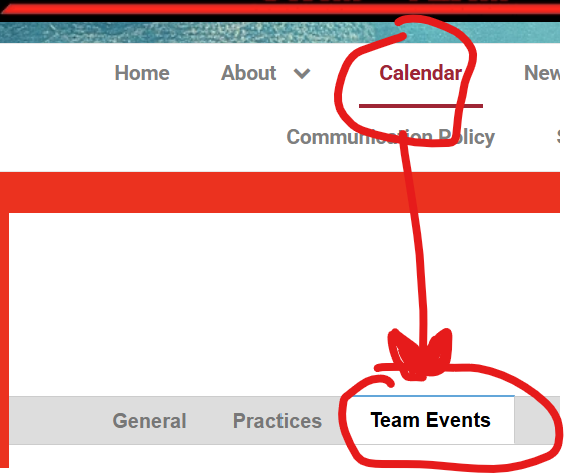
All swim meets that STAR is invited to will be listed under Team Events. Check back frequently as new meet invitations are added as they come into our office.
Click on the Name of the event you want to register for. If a swimmer can only swim 1 day, indicate that in the "Notes" box. The coaches often do the entries weeks in advance to ensure that STAR gets its swimmers into the meet. Once the entries are made and the fees paid, there are no refunds. As a result, early notice of any changes is critical.
Three to four days before a meet, the coaches will post the meet entry information on the STAR web site, for those swimmers entered in the meet. (These are also know as Heat Sheets. More on these further down.)
The Meet Information will typically contain the meet start time, location and directions to the pool. It will also contain information showing your child’s best times in the events they are swimming as well as the time and the event numbers they will be swimming.
Meet Entry Fees
- Parents are required to pay their swimmer’s meet entry fees. Fees are added to the swimmers Team Unify account after the meet. Riptide pays the host club before the meet then parents reimburse Riptide.
- Meet fees vary by location and are set by the host team of the meet.
- It is imperative that all families follow the meet entry accept/decline process outlined below.
- Swimmers are expected to participate in all meets in which they qualify. Once the deadline passes, meet fees are non-refundable EVEN IF A SWIMMER IS A NO SHOW THE FEES WILL BE CHARGED TO THE SWIMMER’S ACCOUNT
The average cost for each swimmer entered in each swim meet is $25. Be aware that different meets have different fees. To calculate the exact entry fee for your swimmer, review the invite pdf file that is posted to the bottom of every event.
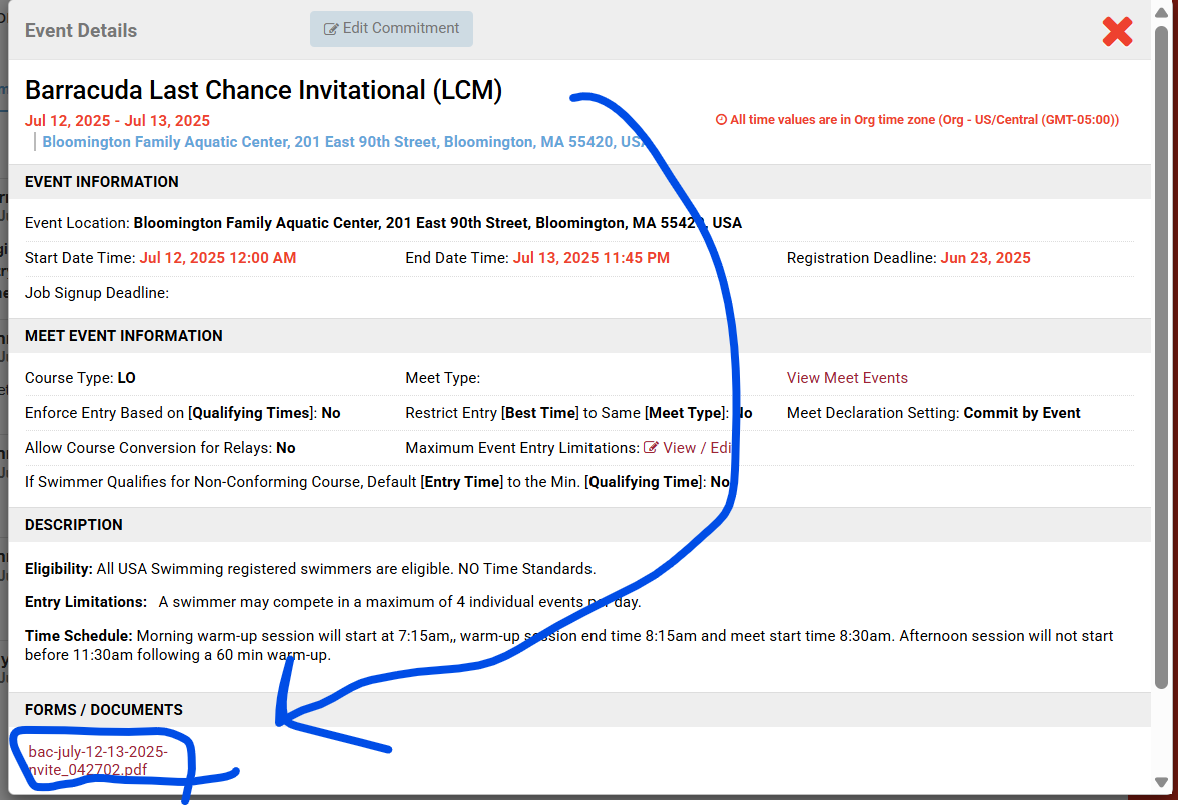
Upon completing your swimmer's registration, the STAR office manager will bill your fee to your STAR account. You will receive an email from STAR Swim outlining the charge and alerting you as to when the payment will be withdrawn from your payment source of choice.
MEET LOGISTICS
Before the Meet
- The Coach will inform swimmers of the events in which they are swimming on or before the day of a meet.
- Directions to away meets may be found on the website, under Meets & Events>Pool Locations.
- Pack swimmer’s gear.
- Pack parent’s gear.
We would like the swimmers to have a paper copy of their events in their swim bag so that they can reference during the meet.
Arriving at the Meet:
- STAR Swim office manager will send an email 1-2 days prior to the meet with information for STAR families. It will include meet details, direction and Heat Sheets for you to download and print at home.
-
Arrive at the pool at least 15 minutes before the scheduled warm-up time.
-
Remember to send your swimmer with a list of their events. This will encourage swimmers to be responsible on deck.
-
Swimmers should locate their team members and coaches in the designationSTAR Swim team area on deck, have your child check in with his or her coach.
-
Remember! Swimmers, coaches and officials are the only people permitted on deck. You will not be able to lead your child to the team area on deck or be on deck at any point during the meet. This is a USA Swimming Rule and will be strictly enforced.
-
-
Once the swimmer has found a spot to sit with the team, they should report back to the coach for their warm-up instructions. It is very important for all swimmers to warm up with the team. Swimmer’s bodies are like cars on a cold day – they need to warm up their engine before racing.
Parents and Spectators: What do you do? Find the other STAR Swim team parents and get an area together. Wear your STAR gear. We want parents to cheer for everyone on the team. Let’s do everything we can to support the goal of being a TEAM. Because parents aren’t allowed on deck, make sure you tell your child to check in with you throughout the meet. However, swimmers should always let their coach know if they are leaving the team area. We don’t want anyone to miss their event!
If STAR Swim is hosting the meet, all parents will have a job assignment to help run a successful swim meet.
During the Meet:
1. It is important for any swimmer to know what event numbers he or she is swimming. The swimmers may swim right away after the warm-up or they may have to wait a while. This is why is it helpful for swimmers to have a copy of the Heat Sheets for themselves. Being prepared is the best way to alleviate nerves and anxiety!
2. When the event is posted, (a sheet of paper with the heats and lanes generated by the Hytek software program), swimmers will write down their heats and lanes. The coaches will pay special attention to brand new or very young swimmers.
3. The swimmer swims their event.
4. After each race: swimmers may ask the timers (people behind the starting blocks at each lane) to know their unofficial time.
5. Swimmers should always say “thank you” to the timers.
6. Swimmers should check in with their coach immediately after their event. The coach will ask their time and discuss the race with each swimmer.
Generally, the coach follows these guidelines when discussing a race:
-Positive comments or praise
-Suggestions for improvement
-Positive comments
What should I do after my swimmer's event?
Tell your child how great they did! You need to tell them how proud you are of them and what a great job they did. Plenty of High Fives and Hugs! Leave stroke and technique analysis to the coaches. Remember - you're there to be their cheer squad and support team. Show them the LOVE.
When the swimmers have completed all of their events and relays and have checked with the coach, then they may go home. At championship meets and dual/tri meets, relays are often included. All relay decisions will be made by the coaches at the meet. If you leave and your child was supposed to swim in a relay, that leaves three other swimmers without their fourth relay swimmer. Always check with the coach before leaving.
What if my Swimmer Cannot Attend a Meet?
If a sudden illness or an emergency prevents your swimmer from competing in a meet that they have entered, please notify the coach or someone else who is going to the meet.
This information is especially important to the coach if your child has been placed on a relay team. If your swimmer fails to appear, the relay may have to be scratched thereby depriving the other three swimmers of their chance to compete. With enough advance notice, a substitute can be found.
MEET MECHANICS
Events Allowed per Swimmer
Each event will have a specified number of events that swimmers are allowed to compete in based on age and ability. Keep in Mind - Multi-Day meets will have a Daily event number maximum number.
Not sure what events your swimmer should choose? Ask them! Talk to their Coach! Don't be shy. Based on the goals your swimmer has set for themselves and what they may be working on at practice - the events might change from swim meet to swim meet.
Order of Events
Each session can last several hours. Bring a book or magazine. Send a card game with your swimmer alleviate boredom.
The rules require that for the younger swimmers (swimmers 12 and under) the planned session is four hours or less. However, problems may arise which extend that time. There is no session time limit for the older swimmers (swimmers 13 and up). Usually the morning sessions of a meet are reserved for the younger swimmers.
Typically morning sessions are reserved for younger aged swimmers while the older swimmers swim in the afternoon session.
NOTE: for Multi-Day meets - you will need to ensure you know what time EACH DAY your swimmer is competing. Events will be spread out over the course of several days.
Each session can last several hours. Bring a book or magazine. Send a card game with your swimmer alleviate boredonm.
The rules require that for the younger swimmers (swimmers 12 and under) the planned session is four hours or less. However, problems may arise which extend that time. There is no session time limit for the older swimmers. Usually the morning sessions of a meet are reserved for the younger swimmers.
Heat Sheets
The Heat Sheet is a paper packet/program that shows all the participating swimmers and what events they will participate in as well as the heat number and lane number.
Heat Sheets can be printed at home and found within the event information. This information can also be found in the Meet Mobile app. Depending on your phone, please search for this in the app store to download and access. There is a fee associated with the app for more advanced information, but all users will be able to search for their swimmer and see the event times
During the event an announcer will say the event and heat number. Sometimes there is also an electronic board with this information.
Pictured below is an example of a Heat Sheet.
This Heat Sheet example shows all of the entries from two teams for the Boys 8 & Under 25 Meter Freestyle.
STAR-MN stands for STAR Swim
Seed Time is the fastest time a swimmer has swum an event.
A: The event number
B: NT means "No Time" has been recorded previously
C: The Heat number
D: The lane number
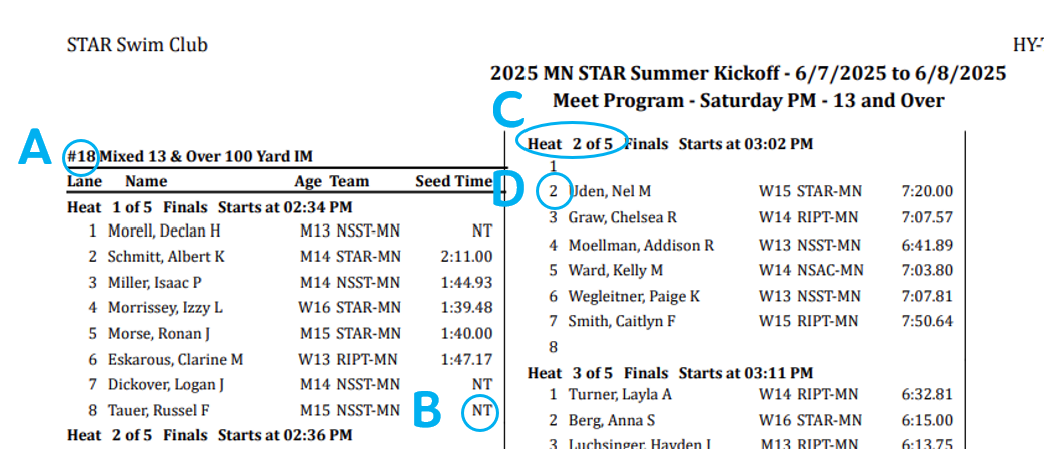
Understanding Your Swimmer's Events on the Heat Sheet
To Understand where in the pool your swimmer will be for their event, see the below example. Knowing this information is extremely important for helping your swimmer keep track of their events.
E: Event
F: Heat
G: Lane
H: Stroke
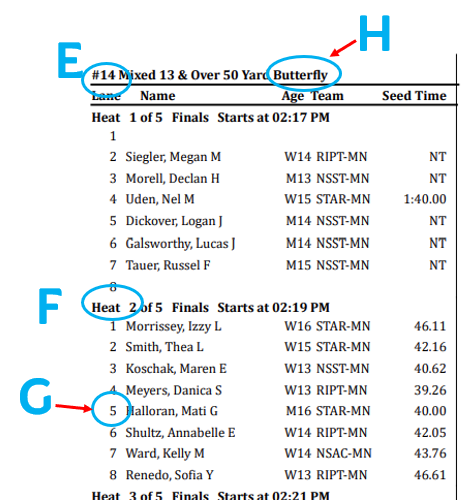
What else Should I Know to Support my Swimmer?
Getting disqualified
Occasionally, a judge will disqualify (or "DQ") a swimmer during their event. Typically, the judge will inform the swimmer of this at the end of their race. Below is a list of common reasons a swimmer is disqualified from MN Swimming Website.
FREESTYLE – This is the hardest stroke to be disqualified in, because there are no real stroke rules. Still it happens.
- Failing to touch the wall on the turn in a multi-lap race.
- Pulling the lane line to gain advantage.
- Standing on the bottom and pushing off the bottom to continue swimming.
BACKSTROKE - Similar to rules for freestyle, except athletes have to stay on their backs (with the exception of turns in multi-lap races.)
- Rolling onto the stomach before completing a one-lap race, or on the finish of a multi-lap race, is a DQ. (This is defined as turning past the vertical-if you are flat on your back, you can’t roll more than 90 degrees, or you are more on your stomach than on your back.)
- THE TURN—This is tricky, but the rule is that swimmers can roll to their stomachs, take one freestyle stroke (with one arm pull down, not two) and, IN ONE COMPLETED MOTION, do a freestyle flip turn and then push off the wall on their BACK. The “one complete motion” part of the rule is fairly objective, unfortunately, and some judges give much more leeway on this than others. A guideline? If swimmers roll over, take their one allotted stroke and then have to kick into the wall for some distance before they turn, they will receive a DQ.
- On the start, the swimmer must surface no more than 15 yards from the starting wall (for older swimmers who do lots of underwater butterfly kicking at the start of a race.)
BUTTERFLY
- One big problem for most young swimmers is the touch on turns and on the finish—both hands must touch simultaneously.
- The feet have to kick together. They can be separated slightly, but they have to stay that way. If the feet start crossing, it’s no longer a dolphin kick, it’s a flutter kick—and it’s a DQ.
- Swimmers can start a race with a series of dolphin kicks under or above the water.
- Some young swimmers get DQ’d for an underwater recovery—you can’t pull down and then recover your arms for the next stroke under the water. If you do, you’re essentially doing breaststroke, not butterfly.
- Swimmers that do not have both arms in unison are in danger of DQ.
BREASTSTROKE - This is the most challenging stroke to get right.
- The biggest problem for young swimmers is the kick—both feet have to be turned OUT in a whip-kick style. Lots of young swimmers turn out one foot, but not the other. This ends up being a scissors kick, which is illegal.
- The second big problem for young swimmers is the touch on turns and on the finish—but hands must touch simultaneously. Both arms must be in unison.
- The third big problem—only one pull-down stroke and one kick allowed on the start. Multiple underwater strokes result in a DQ, because the swimmer’s head must be above the surface of the water at some point during each stroke cycle. (In other words, swimmers can’t go underwater for two or more strokes at a time, during the start sequence or during the race).
General
- More than 1 swimmer in lane
- Start interference by coach/parent/swimmer, especially with relays when multiple people are near blocks, “DO NOT TOUCH” swimmer on blocks.
- Early take off
- Wrong stroke
- Finish in wrong lane
- Missed wall/ no touch
For Other Once a swimmer gets disqualified, they are not eligible to place in that event no matter what their time is.
Every swimmer has been DQ'd at one point or another! Please reassure your swimmer that it is okay and that you are proud of them. The coaches will have tips for them to improve and will go over these with the swimmer in practice.
Diving into the pool
During practices, your child will receive instruction on diving off a starting block. If they are unable to do this, they are permitted to dive off the side of the pool. A swimmer is also allowed to be in the water and push off the side of the wall to begin the event.
How to mark your child - The Swim Grid
In order to help you and your child keep track of their specific events at the meet, most swimmers or families mark the events on the child similarly to the example below. First, highlight all places in the Heat Sheet where your child's name is found. Then, use that Event, Heat and Lane information to create a grid/list on your child's arm in permanent marker.
Make four (4) column headings - E, H, L, S. These stand for Event, Heat, Lane and Stroke. Go through the heat sheet and find your swimmer's name which you highlighted. For each event, write the event number, heat number, lane number and stroke in the corresponding column.
Note: For younger swimmers, write your swimmer's name in big letters on his/her arm or back. This helps the volunteers who are lining up the swimmers at the starting blocks.
In this example, the child is swimming:
Event #11, Heat 4, Lane 4, 25M Freestyle
Event #31, Heat 1, Lane 6, 25M Backstroke
Event #41, Heat 2, Lane 3, 25M Breaststroke
Event #59, Heat 2, Lane 4, Free Relay
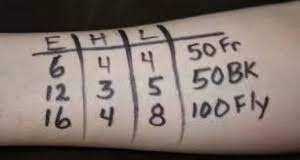
Each swimmer is responsible for their own event schedule. Listen carefully as the events are called so that you do not miss your event.
At the conclusion of the meet, the Sharpie can be removed with alcohol-containing hairspray, hand sanitizer or rubbing alcohol.