
Practice Is Everything: The Mindset Behind Superhero Workouts
By Olivier Poirier-Leroy
If excellence in the water (or anything else in life for that matter) is important to you, and it is something you are struggling on achieving, than you need to rethink the way you approach practicing.
Here is just some of the cool stuff that happens when you start acting like practice is everything.
1. You start doing the “little” things waaay better.
When we talk about the things we want to accomplish in the sport it’s usually in terms of records, medals and placings. It’s the final result we fixate on, and as a result, practice as a mechanism for making that happen gets pushed to secondary status.
We dream about our big goals, while treating our workouts as a nightmare that we have to endure.
Makes sense–winning a gold medal in world record time, and daydreaming about it, is fun and doesn’t require any effort. Showing up every day and going all-in with your practices requires all of your effort.
When your mindset is on walking onto the pool deck with an “I’m going to compete my chlorinated pants off today!” the focus is on preparing to practice fast every day.
When you treat your practices with as much diligence and focus as you would for the big meet some powerful changes start to happen.
Two examples:
- Paying more attention to sleep. Ever notice that the week before the big meet you suddenly do everything you can to start getting adequate sleep? The rest of the training cycle you cut corners on your Z’s, even if you know about the performance decline that occurs as a result. Getting the sleep you need to perform in practice becomes more of a focus when training goes up the priority list.
- You eat for performance. Although swimmers like to think that they can get away with murder in the kitchen because of the volume and intensity of their workload, how and what you fuel yourself plays a pivotal role in how you fare in training. When you consider your food choices with the same deliberation before your swim practice as you do before the big race your food choices inevitably improve.
2. You clean up your training habits.
I’ve been guilty of swimming almost countless garbage meters over the course of my swimming career. Had I taken even a fraction of those practices and meters more seriously who knows where the sport would have taken me.
Excellent practices produce excellent swims. It’s as simple as that.
To be more specific:
- If you explode out of every one of your streamlines your breakouts will not only get immeasurably better, but they will always be there for you because it has become habitual.
- Same goes for your flip turns: speed into the wall and launch yourself out of every turn and suddenly your “normal” turns become “elite” turns.
Practice is where you build the foundation of your races. How you finish high intensity reps in workout is how you are going to finish them in competition.
Practice is also where you can get down and dirty with your swimming without worrying about screwing up.
After all…
Competition is expected to be done with perfection—there is no room for testing.
Practice, however, is where you can scrappily work at your swimming. Different breathing patterns, testing underwater dolphin kick combos, and so on.
3. You control how you practice.
Being a practice-minded swimmer sounds like it would be super stressful, doesn’t it? At first blush it could seem like a mental burden that would be exhausting to carry.
Not so–it actually gives you ultimate control over your performance.
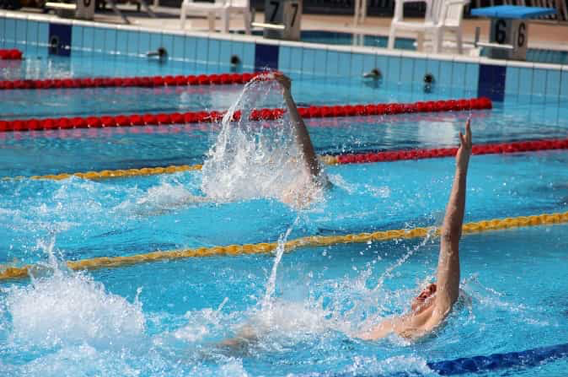
How things go down at the big meet isn’t completely under your influence—how the kid in the next lane swims, or how bunched up the events are, isn’t something you can control.
But the way you practice, how you choose to compete within each set against yourself is something you can control.
Don’t underestimate the power of feeling in control of your training.
Let other swimmers worry and fret about the things they cannot control—take your energy and focus and drive it face-down into the things you can control. Your compete level, your effort, your focus, doing the little things right.
By having a “always compete” attitude where all you think about it working as hard as you can today the end result almost becomes a bit of a moot point.
You can relax a little bit about the outcome for a few different reasons: you know the work is being done, and that the result will take care of itself.
4. Great practice means you are always ready to punish the competition.
A “practice is everything” mentality means you will always do your absolute best no matter what the circumstances are. It doesn’t matter if you are tired, your goggles are leaking, the pool is extra wavey–whatever the case, you bring the thunder.
And this type of resilience, this kind of mental toughness plays a massive role in how successful you are going to be in the long run in swimming or anything else in life: It’s one of the key things that research has shown to separate super champions from “almosts”.
There will always be workouts where you are tired, stressed, not feeling the water, but if you are always bringing it, and not saving a full-blown effort for when you “feel like it” you develop a bullet-proof ability to crush it any time.
By having an “always on” attitude you are ready to drop a thunderous performance anywhere, anytime.
And this kind of swimmer is almost impossible to beat.
5. You have one gear—excellence.
If you took an average of your effort and focus in practice how would you rate yourself? Do you find that you bounce up and down with how you perform in practice?
- When you are stressed out about personal life drama your workout suffers.
- You use “not feeling motivated” as an excuse to not work hard.
- Not having enough of something (time, resources, expertise, etc.) as a crutch to not take action or give your best.
These excuses fall away quickly–a “practice is everything” mindset forces you to make excellence habitual. It makes showing up and giving your best the baseline.
You shouldn’t practice at a level that is below the grade you want to achieve. You don’t to D-grade studying and expect to get A-exam results.
When you treat practice seriously this approach to being excellent all the time will inevitably infect the other parts of your life.
Showing up to practice and putting in full effort every day will transform the very foundation of who you are at a person. (How is that for hyperbolic?)
The Next Step:
What does a “practice is everything” mindset look like?
Does it mean being perfect at every practice?
No way. Perfectionism is over-rated, and actually more likely to leave you stalled out than actually taking action.
Here is what a “practice is everything” mindset produces:
- You do the best you can with what you have.
- You perform at your best no matter how tired you are, or how you are feeling that day.
- You prepare for your workouts with the same focus and consideration you prepare for competition.
- You compete at every opportunity with yourself to be better.
But…but…what about competition?
“Shouldn’t I be focusing on getting more amped up for the big meet?”
The good news is that for most of us, taking the big meet seriously isn’t the problem—it’s usually the opposite, of being able to walk on deck at the biggest meet of the year and having the poise and training background to be able to treat it like just another swim.
When you treat practice as everything, when you treat every time you walk out on deck as another opportunity to unleash your best, performing to your max at the big meet becomes almost automatic.
The Research Behind the Mindset of Super Champions
By Olivier Poirier-Leroy
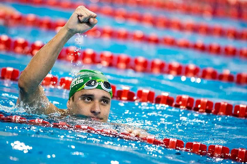
Recent research sought out to see what commonalities elite athletes possess. Here are 5 things that top achievers do that “almost champions” don’t.
What does it take to be a champion?
Sure, we can look at a swimmer like Michael Phelps and say, “He’s talented and works hard,” but what we really want to know is how much of that success is talent, how much is genetics, and how much of it is environment.
We want to know the ingredients of greatness so that we can bring it out of ourselves (or perhaps, as I suspect, we are looking for the big spoiler: we want to know if the work is going to be worth the effort).
As one fascinating study of champions of all levels from numerous sports found the keys to greatness are fairly consistent. And as the findings show, the things that separate the “super champions” from the athletes who were on the cusp were quite clear.
The 5 Keys to Being a Super Champion
The research, published earlier this year, included a series of interviews and questionnaires with a group of 54 athletes. They included top achievers (“super champions”), champions and “almost champions.”
There were several things that made the top performers stand out above the rest:
1. Fierce desire to overcome challenges.
Whether it was coming back from an injury, or being cut from a team, the top athletes in the group faced these missteps with a determined resolve. They were also very proactive about training at a high level.
“I always felt that there’s no chance, nobody or anybody could train more than I did. I always had that confidence,” said one athlete.
The high achievers tended to face challenges head on, employing a “how am I going to learn from this?” attitude that the “almosts” generally lacked, who often appeared surprised by challenges and failure.
2. Constantly setting new goals and challenges.
For most swimmers reaching an end-of-season goal is the destination. Satisfied they lean back and don’t refocus on the next goal.
High performers don’t sit on their laurels, satisfied with what they’ve done to date. They are continually moving the yard-sticks, setting new goals and never allowing themselves to be completely content.
They viewed each victory as a stepping stone to the next level. From one of the participants: “I always wanted to do something else, always planning.”
3. Setbacks tend to ignite hyper development.
We all face failures, setbacks and disappointments over the course of our swimming. Whether it is a pair of broken swim goggles, injuries, or a disappointing performance, champs wield it to their motivational advantage, using them to launch themselves to the next level.
Whether it was an injury, “That injury was pretty critical…I was determined to get back” to being cut from a team; “I just did double everything [after not being selected]” the big setbacks were usually big turning points.
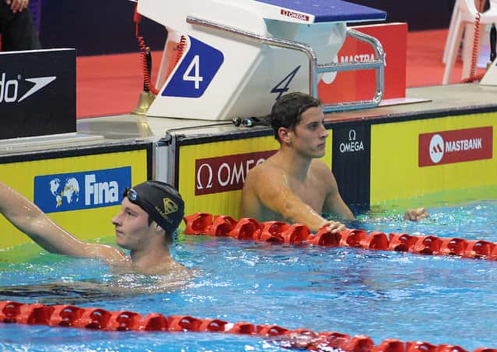
One quote in particular stood out.
The athlete had experienced every athlete’s worst nightmare—an injury so bad that it was possible that it was career-ending. If you have ever been down the injury rabbit-hole you will recognize the mental back-and-forth that happens when we are sidelined:
“There were days when I was like ‘Why is this happening to me? I am so frustrated, what am I going to do? How long is it going to take me to get back?’ But then the other days were like, ‘right what do I need to do? I’m going to do this, do this and get back’. But I never, ever thought I wanted to quit. I think I still would have worked hard and still trained and done everything I could have done. But I think it gave me a different mental capacity. Because I’d never had to deal with anything like that before, so I definitely did think it changed me and made me achieve what I then went onto achieve.”
Think back to the last truly disappointing meet you had.
Did you come back with twice the determination and commitment to improve? Or did you choose to let the poor performance be an indictment of your swimming?
4. High performers are intrinsically motivated.
Clear differences were found in how the various groups of athletes viewed their sport and what they found rewarding and motivating.
The high performers tended to engage in a lot of reflection on their own performances (something that sounds a lot like Caeleb Dressel and the way he uses his training log to reflect on the way he trains in the water).
One athlete found the ritual of reflecting in his training log to be an utterly critical part of improving:
“After every event and training session I would complete my diary, highlighting areas for development and setting goals…I had to do it or I was pissed with myself all day.”
While the high performers tended to focus inwards, the “almosts” tended to motivate themselves via what other athletes were doing.
Monitoring the performances of the competition incessantly and allowing their mood to be affected by how they did, for example. Motivation happened by way of external influences instead of the things they could fully control.
5. The parents and coaches weren’t pushy.
From purely anecdotal experience I can say that very often the best swimmers come from families where the parents are hands-off.
This doesn’t mean the parents don’t care, or that they don’t help with the carpool, etc; quite the opposite. They do the parenting stuff, and let the kid do the swimming stuff.
As a result, the swimmer has the sport for themselves, is able to take ownership of their training and performances, and as such, help them find their own motivation to engage in the sport.
The parents having a “backseat” approach was consistent with the super champions. While the parents were supportive and interested in how the athletes did, they weren’t major drivers of improvement.
“They were supportive, but they didn’t drive me, they didn’t push at all,” said one athlete.
Interestingly, the coaches of the top performers were also reported as being relaxed, focusing on the long term development of the athlete even though the athlete was usually more focused on the shorter term goals and ambitions.
I know as a youth (and maybe still on occasion) my coaches had to deal with my impatience in this regard. Like most young swimmers I wanted my results and I wanted them right away.
The coaches of the top performers managed the expectations and advocated a longer term approach:
“[My coach] was great in the fact that he never wanted to rush anything where as I always did. I wanted to be better, and I wanted to start winning things straight away. He always had in his mind that it was a long journey.”
Whether intentional or not, the parents and coaches created a situation for the athletes where they were intrinsically motivated, and not training and competing in order to please others or for external rewards.
The Takeaways
Ignoring things like genetics and talent for a moment, being great, in the face of this research, isn’t all that complicated.
It’s about adopting a mindset that thrives in the face of setbacks, finds internal pleasure and reward in the work being done, keeping an evolving set of goals, and having an environment that allows you to take accountability of their swimming.
Those are the things you can control. And if there is one thing this study shows, it’s that the way you react to the conditions you are dealt with dictates the way you eventually perform.
How to Master the Process of Becoming an Elite Swimmer
By Olivier Poirier-Leroy
If you really want to accomplish your goals in the pool you need to stop focusing on them and instead work on crushing the process. Here’s why.
Goal setting is a trip. We choose something we really, really, really want to do in the pool and then end up giving ourselves a metric-ton of stress and anxiety over it.
- “Will I actually accomplish my goal?”
- “I have so much work to do still, I don’t know if I can do it…”
- “What happens if I don’t swim the time I want to?”
The stress and anxiety comes from uncertainty. Because no matter how much we want something there is no guarantee that it will come to pass.
The solution? Mastering the process.
Your coach has probably already told you a couple times about the need to master the process. About why you should focus on the day-to-day grind of becoming a better swimmer.
Today I am going to quickly show you why the process is critical to improvement. How it’s been proven (with actual research) to produce better overall results and even make training more enjoyable.
If you are serious about wanting to crush your goals in the water, you need to start by mastering the process:
Master the Process, Master the Pool
What is the crux of mastering the process?
- It’s taking what looks like an almost impossible result or situation, and breaking it down into manageable chunks.
- It’s taking that Olympic gold medal and separating it into months, weeks and days of what your training is going to look like.
- It’s taking the goal time you have for the mile and boiling it down into measurable, actionable things you can do to improve your technique, conditioning and lifestyle.
Seems easy enough, and yet, so many swimmers seem to struggle with it.
I surmise that this is because a routine is harder to measure. As swimmers we live and die by the pace clock, and a routine isn’t always as clear-cut as the cold, hard digits on a scoreboard.
And our routine also isn’t—for a lack of a better word—all that attractive.
The results we want bring us immediate satisfaction and glory. The very word “routine” doesn’t exactly inspire excitement. And while it may be tedious, or boring, it’s actually the thing that truly drives performance in the our swim workouts.
After all, here are some of the things becoming a process-driven swimmer does:
Reduces stress.
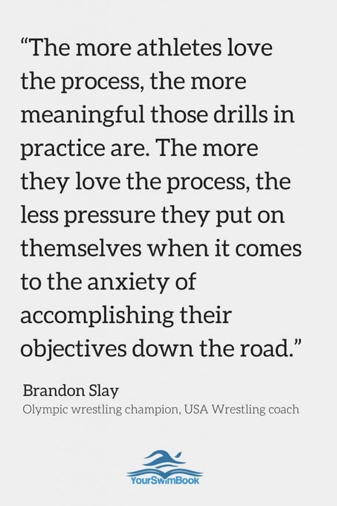
When we get lost in the process we remove the uncertainty of the results. Put more simply, by doing the things we can control we remove the anxiety that comes with thinking about the things we cannot control.
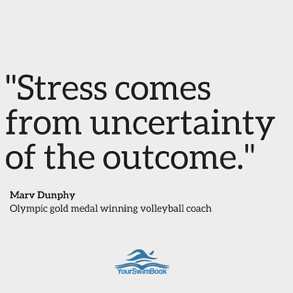
“Stress comes from the uncertainty of the outcome,” notes Marv Dunphy, Olympic gold medal winning volleyball coach.
Whether it is in practice or in competition the effects are the same. Stress has a way of melting off when we focus on the next step in our preparation and not what the swimmer in the lane over is doing.
You actually live the goal instead of chasing it.
Instead of “becoming” a champion swimmer on a specific date via a specific goal, you build and encapsulate the processes and routines of a championship swimmer.
Records and gold medals are won a thousand times in practice before they are captured in a fleeting moment at the big competition.
Confidence comes from the process.
As much as we like to think otherwise, we don’t have much control over our results.
Other swimmers are going to swim the way they are going to swim. The meet conditions will be what they are. There are things you cannot control, but your effort in mastering the process is something you can.
Whether you show up today at practice and give a great effort is wholly on you. This internal focus is empowering, develops self-esteem and of course, promotes better and faster swimming over your career.
You’ll end up working harder and enjoying the work more.
Goal setting is important, but when we stay focused on our goals it ends up detracting from the inherent pleasure that comes with working towards something we care about.
And more strikingly, being goal-obsessed actually ends up hindering performance.
A study performed by researchers at the University of Chicago and Korea Business School found that when a hundred students at the university gym were split into two groups, with one asked to describe a goal (“I want to get in shape!”) and the other to describe the experience of what they were about to do (“I am going to loosen up, and then run on the treadmill”) differences quickly emerged.
On the one hand, the “I want to get in shape!” group intended to run for longer on the treadmill than the experience group. Only that wasn’t the case.
The experience group crushed average time on the treadmill, lasting 43 minutes compared to the goal group’s 34 minutes.
Not only that, but those who were focused solely on the goals or results of working out reported feeling more winded and gassed after the exercise.
When it becomes about enjoying the experience versus hoping for results the participants both worked out for longer and spent less effort doing so.
How Build a Routine for Success in the Water
Okay, so by now maybe it’s starting to really sink in that you need to spend more time working on your process.
But where to start?
Here are five suggestions for building yourself into a process-oriented swimmer:
Have a plan.
While your goals start with a written representative of what you want to achieve, mastering the process starts with having a plan.
What does your ideal week of training look like? Your ideal day of training? What is the routine that is going to get you to where you want to go with your swimming?
When crafting your plan stay in the realm of things you can control. This means not focusing on times that you want to perform in practice, and instead think in terms of mastery of effort.
Have measurable things to do.
Swimmers have goals. Times they want to perform when it comes time to stepping up on the blocks.
If pressed a little further, they might even be able to tell you what they need to do to get there: improve my start, better turns, higher level of conditioning.
But for many, that’s where it stops.
If you need to improve your start, what is a measurable thing you can do each day at practice to better your start? If you need to improve your conditioning, what is something you can do each day or each week to make this happen?
The profound power in the process comes from taking what looks like an almost impossible goal and breaking it into manageable and measurable chunks.
Celebrate the little wins.
We are conditioned to only stop and celebrate the big, momentous occasions in our swimming career.
The record. The gold medal. The team championship.
Positive reinforcement and celebration doesn’t need to be limited to these occasions. Recognizing that you gave a 10/10 effort that day in practice makes you want to do it again tomorrow.
Take a moment to recognize the small wins. I can understand wanting to brush aside these little victories as not being significant enough to warrant being noted, but they are.
Small wins beget more small win, and in our relentless push to achieve excellence the more mini-wins we accrue the better.
Make your goals effort and consistency.
You can’t always control how you are going to feel in the water on a daily basis. There are times I slip in the water and I feel utterly unstoppable, while on others I feel like I am swimming through molasses.
Regardless of how the water treats me that day, I am going to give the same effort.
Invest in the work and effort, the results will spring naturally from them.
Get feedback from your coach.
You shouldn’t be waiting until race-time to find out if things are working in training or not. Regular feedback is critical. Here’s an example.
In 2011 Katie Ledecky and her coach Yuri Suguiyama were having some communication issues. Suguiyama knew there was more to be gleaned from his young protégé, but for Ledecky, who is naturally reserved wasn’t offering much.
The answer?
Suguiyama had her write out her workouts plus her thoughts in a training log.
At the end of each week he would add his own notes and thoughts, creating a regular evaluation that included feedback that reinforced the things that were working, while giving both athlete and coach a more open line of communication.
Feedback better informs the process, so sit down with your coach regularly in order to tweak and improve your routine and swimming.
Why Change is So Hard in the Pool (and How to Make it Easier)
By Olivier Poirier-Leroy
The world record. The gold medal. The underdog who overcame the odds.
We are suckers for dramatic stories about swimming.
It’s the “Big Wins” that captivate us.
After all, they come charging through our screens like a drunk moose:
· “He turned his life around, committed himself to showing up to practice, and after a few months was on top of the podium!”
· “She was injured, sick, and had no chance of qualifying for the Olympic team. She didn’t let anything stand in her way and now she’s Olympic champion!”
· “I changed up my training and dropped 8 seconds in my 100 freestyle in just three months!”
These stories, because they are so dramatic have a way of giving us the false impression that the way to achieve big things in the pool is with massive, violent change. The key to crushing it, we take from these stories of epic willpower and strength, is to hammer down and bareknuckle-brawl our way through the obstacles and change before us.
But if it’s faster swimming you want, if you are serious about slapping your personal best times around, you need to stop fixating on the big stuff and work on achieving more Little Wins.
Let me explain.
We All Want the Overnight Success Story
Alrighty, so you’ve had your “enough is enough” moment, or you’ve been hit with a large slab of motivation, and you’ve decided that now is the time to make some serious change in your swimming.
It’s time to achieve some crazy-savage stuff in the pool.
Your goals in the pool are gonna get it.
First of all, good on you.
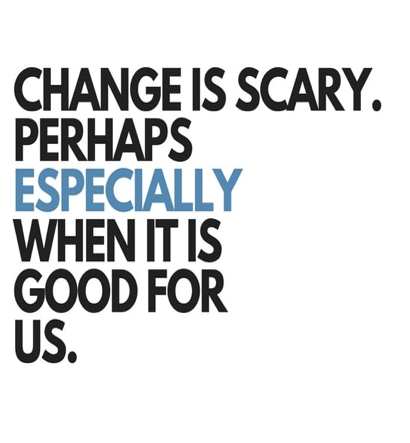
Second of all, change is hard. Even when it’s good for us.
The ways that we make it even harder are nearly endless: We try to change everything overnight. We try to motivate ourselves solely from a negative emotion (regret or guilt). We underestimate progression. We half-heartedly commit to the change. We don’t align our environment to make things easier. And so on.
But one of the lesser-known reasons we stay stuck is because, well, we actually kinda like being stuck. We are comfortable there. We feel safe.
Even if our present circumstances don’t make us super happy, our brain reasons that this is still better than the uncertainty of making a change.
Big Change Starts and Ends with Little Wins
The concept of Little Wins isn’t revolutionary. There are a few different terms for it: kaizen, master the process, marginal gains, and so on.
It certainly isn’t glamorous, and it isn’t going to make for good fodder when giving your post-race interview after smashing a world record, “Oh, you know, I just improved little things here and there, consistently over a long period of time. Pretty cool, huh?”
But Little Wins are legit.
And they can work for anyone, whether you are getting back in the water after a year long layoff or trying to reach the pinnacle of the sport.
Here are the three big ways that Little Wins can help you swim better and more consistently this season:
1. Little Wins are a harmless “Bob the Builder” for your brain.
Even though the big change is something we crave, there is a part of your brain which absolutely does not.
For a moment, let’s go to Metaphor-town and think of your brain as a well-manicured home in the suburbs. The temperature is regulated, the furniture is laid out in an orderly fashion, and everything is just right. It’s comfortable. It’s predictable.
When Overnight Change shows up at the front door with a wrecking ball and a ten-man construction crew, the security system goes five-alarm crazy. Everybody scatters, and even though the house isn’t perfect, and it might have been much improved in the long run, for now it continues to be safe and comfortable.
Our brain, in the name of keeping things normal, scares off anything that looks like it might be a threat to the status quo.
But then Little Wins come along.
It’s just one guy with a little hammer. No wrecking ball. No jackhammer. No elaborate renovations. Maybe a couple new pictures. Some new drapes. Nothing crazy. Nothing threatening.
Come on in, Bob the Builder!
2. Little Wins are a Trojan horse for the Big Wins to come.
Starting off slow and easy might go against everything you stand for, but it makes turning up the volume and intensity down the road much easier when you already have the habit partially grooved in place for yourself.
Your brain is a lot needier than you realize. It craves comfort, safety and homeostasis. Anything that threatens this is immediately flagged for review and placed in the spam folder. But Little Wins?
Well, they are just so harmless-looking and cute that they can side-step your brain’s spam review policy and land in your inbox. (Wow…am I stretching it or killing it with these metaphors?)
Little Wins give you a sense of momentum that help ramp up and escalate the change you want to make in your swimming and your life.
3. Little Wins provide thousands of sparks.
Whenever we do something well, whether it is holding the breathing pattern for that lung-buster pull set, keeping our head down into the finish at the end of each rep, or completing the whole workout exactly as it is supposed to be done, we get a nice little hit of dopamine.
It feels good. We feel a sense of accomplishment.
Compare that to fixating on the Big Change. Because it can only happen once, we exist in a state of feeling “less than” until we have our opportunity to decide whether we achieved it or not. This is a flawed strategy, as it gives you nothing to work on in the short and medium term.
Little Wins give us, well, wins that provide confidence, motivation and the realization that we are on the right track. Sure, each of those mini victories might seem inconsequential compared to the big goal, but don’t underestimate their power: they keep the motivational flames burning and smoldering so that you get up on those early mornings.
Little Wins will help your mindset stay positive and on the day-to-day things that will actually impact your performance down the road.
Little Wins: Where to Start
There are always going to be ways we can improve as swimmers. The list of things we can change, boost or even cut out are never-ending.
This avalanche of opportunity gives us hope, yes—look at alllll that improvement just sitting there for the taking—but it gives us an infuriating quandary: with so much to do, with so much to fix, we don’t even know where to begin. So we usually don’t. Or we will try to do it all at once…and burn-out and crash as if we sprinted the first 200m of a 1500m. Fly.
Change is hard. Even when it’s good for us. Perhaps especially when it is good for us.
Resist the urge to wholesale change everything: this approach rarely works out. Instead, take a look at some of the big things affecting your swimming and introduce them to Bob the Builder.
Here are some examples:
Nutrition: If you looked at the sum of your meals over the past week, do you think you could improve 4-5 of them? Could you sub out sugary drinks at a couple of your meals for water? Instead of completely revamping your diet, look a couple things you can adjust.
Recovery: What little things could you be doing to improve your recovery? Even just by a little bit? Here are some simple ideas that take little effort:
· Put a banana and a protein shake in your swim bag every day so that you have something for post-workout.
· Go to sleep 20 minutes earlier each night.
· Write out a 3-point gratitude list in your training journal.
Staying hydrated: Every cellular process that happens in our body requires some of that delicious H2O. You already know that you should be crushing water in and around your practices, but are you drinking water the rest of the day too? Drink a glass of water when you wake up. How’s that for a small goal?
Technique: What is one little thing you can easily do for the whole practice today?
You don’t need to swim the entire practice with 100% flawless technique (well, that’s the goal, but if you are swimming at 20% awesomeness currently let’s start by leveling up to 30-40% to begin with).
It costs you little to do one thing technically awesome for a full swim practice.
A tighter streamline. A little more undulation on your dolphin kicks. A slightly higher elbow.
The Next Step
Now, I know what you are thinking: this way is too slow.
To which I would say, Yes. It’s slow. It requires patience, which the Overnight Change story has conditioned us to not have.
But Little Wins are much faster than the perpetual start-and-stop that comes with trying to change everything at once.
If it’s dramatics you want, go to the movies.
If it’s change you want, pick away at your swimming in small and doable chunks.
