News
PST Entries Events 1-6 Friday June 18 Warm up @ 5pm Events 7-24 Saturday June 19 Warm up @ 7am Events 25-42 Saturday June 19 Warm up @ 12:30pm Directions to Academic Village : Take I-75 South to Sheridan and head West. Make a right at 172nd, pool will be on your right. The address is 17191 Sheridan St . , Pembroke Pines , FL , 33029
How to Be a Good Sport Courtesy of The Nemours Foundation "No fair!" "You cheated!" "It wasn't my fault we lost!" Have you ever played on a team with somebody who hated to lose? Or maybe you have a tough time if you lose anything — even a game of tic-tac-toe. Some kids find it extra-hard to lose, but everyone needs to learn how to do it. Learning to lose without losing your cool is a skill, like learning to ride a bike. You might not be able to do...
FAQs for the day Q: My son complains that some of the kids in the lane skip laps. He doesn't think that's fair. What should I tell him? A: Praise him first for completing the workout the coach offers. Remind him that he is there to improve his own swimming and he can’t control what his teammates do. Tell him however, that his best course of action is to continue to do things right and others may actually be influenced by his good example. By committing to do his best...
What Would You Say to Save Swimming? by: Mike Gustafson, Senior Analyst Courtesy of Swimnetwork.com I woke up this morning to an email from a Swimnetwork reader regarding an interesting and unfortunate predicament: This reader's high school program is being eliminated. In a few days she will travel back to her hometown to speak in front of the school board addressing this issue. She asked me what to say if I were in her position, standing in front of a somber group of adults faced with a budget crisis and...
FAQs Q: My daughter's coach makes her sit on the side of the pool. What's that teaching her? A: The coach has set up expectations of proper behavior both in and out of the water. Hopefully, your child is aware of the consequences of testing these boundaries. Obviously the coach is reinforcing what is expected of the children at practice. We encourage you to reinforce the coach's practice expectations by discussing your child’s behavior and the consequences of that behavior. Hopefully, this “time out” begins to reinforce self-discipline, accountability and...
Courtesy of USA Swimming UNDERSTANDING YOUR PHYSICAL GROWTH AND DEVELOPMENT Did you know? Athletes follow a predictable pattern of physical growth but the rate at which you go through this growth varies by individual. Consider… You typically grow about 2.5 in/yr and gain about 5 lb/yr. Your growth spurt occurs during puberty/adolescence. This means that someone the same age as you can vary by as much as 5 biological years, meaning with two 11-year-old swimmers, one may be 10 and the other 15, biologically. What can you do? Be aware...
FAQs Q: My child seems to be bouncing off the wall during "taper." What is that? A: Tapering is a gradual reduction in training workloads in preparation for major competition. Some Age Groupers do not need to taper at all: a little rest and they are ready to go. As training increases, swimmers need more rest and the process of tapering is introduced. Swimmers taper only a couple of times a year, for their major competitions. Taper is not something that occurs for every meet! “Taper time” is an exciting...
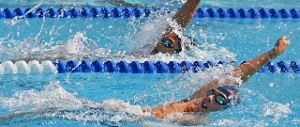
Courtesy of USA Swimming THE FOUR STROKES The four competitive swimming strokes are freestyle, backstroke, breaststroke and butterfly. The combination of all four strokes is called individual medley. In freestyle events, the competitor may swim any stroke. The stroke most commonly used is sometimes called the crawl, which is characterized by the alternate stroking of the arms over the surface of the water surface and an alternating (up-and-down) flutter kick. Backstroke consists of an alternating motion of the arms with a flutter kick while on the back. On turns, swimmers...
Training and Workout Questions for Athletes What type of commitment is needed for higher levels of competition? While your performance is influenced by numerous factors, there are three that exert the greatest influence: physical, technical and mental. As you progress through the sport, a greater commitment, of both time and energy, is needed to enable you to address all of these factors. Additionally, you will be asked to take more responsibility for and ownership of your practice and competition performance. One way of doing this is by accepting responsibility for...
Dear PST Swimmers, Parents, Family and Friends: I would like to invite ALL PST SWIMMERS to Swim for MS on Monday, June 21, 2010 @ Plantation ’s Central Park Aquatic Center . It’s easy to earn while you train . What is MS? Multiple Sclerosis (MS) is one of the most common neurological disorders diagnosed in young adults. It is an autoimmune disease that affects the brain and the spinal cord. We know that our brain acts like a computer that sends messages to your body telling it what to...