- Goal Setting & Intrinsic Motivation: Swimmers work toward personal bests and achievements.
- Confidence Building: Overcoming challenges boosts self-esteem.
- Social Connections: Swimmers bond with teammates and meet peers from other clubs.
- Skill Development: Competing refines strokes, turns, and starts.
- Experience: Swimmers learn the rules and routines of competition.
-
Trust your swimmer: Swim meets are a chance for your swimmer to build independence and confidence. Allow them to manage their races and learn from the experience.
- Trust the coach: Your swimmer's coach should be their first point of contact after a race. Encourage your swimmer to seek feedback from their coach rather than stepping in yourself.
- Trust the experience: Whether it’s a missed swim, a disqualification, a slow race, or something unexpected, these moments are opportunities for learning and growth.
- Team spirit matters: Encourage your swimmer to sit with their team between races. This builds camaraderie, keeps them updated on the meet, and ensures they’re ready for their events.
- Get involved: Swim meets rely on volunteers! Becoming an official is a rewarding way to support the team, stay engaged, and gain a deeper understanding of the sport. Plus, we provide free training and guidance to get you started.It is the best seat in the house!
-
Know the details: Check the meet package for warm-up times, event schedules, and the pool location. It is important to check it again the week before the meet as things may have changed.
- Pack ahead: Encourage your swimmer to pack their own bag so they know where everything is and are ready to race.
- Arrive early: Aim to be on deck 15 minutes before warm-up so your swimmer can check in with their coach and get ready to warm up.
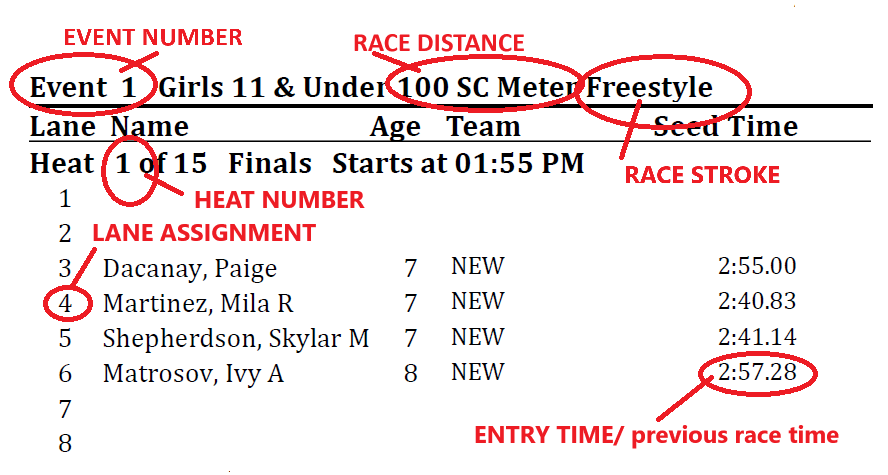
- Stay informed: Use Meet Mobile or Heat Sheets to track your swimmer's events, heat, and lane assignments throughout the meet.
- Competition suit + spare
- Team cap + extra cap
- Goggles + backup pair
- Towels (2-3), slides/flip-flops
- Warm clothes (track pants, sweatshirt)
- Water bottle and healthy snacks (snacks should not be eaten on deck)
Before the meet begins, the pool opens for all swimmers to warm up. It’s an important part of their preparation, helping them get physically and mentally ready for their races. Expect a lot of movement and noise—it might seem chaotic, but every swimmer is focused on their coach’s plan to ensure they’re ready to perform their best.
Warm-up rules MUST be followed at every meet to ensure safety and efficiency:
- Feet First Entry: Swimmers must always enter the water feet first.
- Circle Swim: To maximize space, swimmers circle within their lanes.
- Sprint Lanes: Near the end of warm-up, designated lanes will be available for dive or backstroke starts. These are single-directional lanes; swimmers exit at the far end and cannot cross lanes.
- Equipment Rules: Kickboards and pull buoys are allowed. Fins and paddles are not permitted.
Race Time
- Pre-Race: Swimmers track their races using the heat sheets and the scoreboard. 2-3 heats before their race, they check in with the official in their lane or head to the marshaling area.
- Long Whistle: Swimmers step onto the block. For backstroke, they enter the water, and a second long whistle signals them to grab the handrails and prepare.
- "Take Your Marks": Swimmers get into starting position.
- Start Signal: A tone or beep signals the start of the race.
- Recall: If there is an unfair start, there will be an additional sound from the starter and the referee may blow their whistle. Some pools may also have a rope that stretches across the pool. If your swimmer hears the recall sound, they should return to the start to receive more instructions.
- Post-Race: Swimmers check their time on the scoreboard and head to their coach for feedback.
- DQ (Disqualification): A DQ indicates a violation in stroke, turn, finish, or start. It’s a normal part of the learning process and can happen to swimmers of all levels. Swimmers should get clarification from their coach on why they were DQ’d and how to improve.
- Competitive Strokes: The four competitive strokes are freestyle, backstroke, breaststroke, and butterfly.
- Individual Medley (IM): An event in which swimmers swim equal distances of all four strokes in the following order: butterfly, backstroke, breaststroke, freestyle.
- Relay: A race where four swimmers each swim one leg. There are two types:
- Freestyle Relay: Each swimmer swims freestyle.
- Medley Relay: Each swimmer swims a different stroke, in the order: backstroke, breaststroke, butterfly, and freestyle.
- Seed Times: The times swimmers use to enter a meet, determining the heat and lane assignments.
Heat Sheet: A list that shows the heats, lanes, and swimmers for each event. Heat Sheets are categorized into Event, Heat & Lane
- Event: A race in a specific stroke and distance.
- Heat: A single race within an event. If there are too many swimmers for one race, the event will be broken into multiple heats. Heats are generally swum from slowest to fastest, with the final heat featuring the fastest swimmers.
- Lane: Lane the swimmer will be in